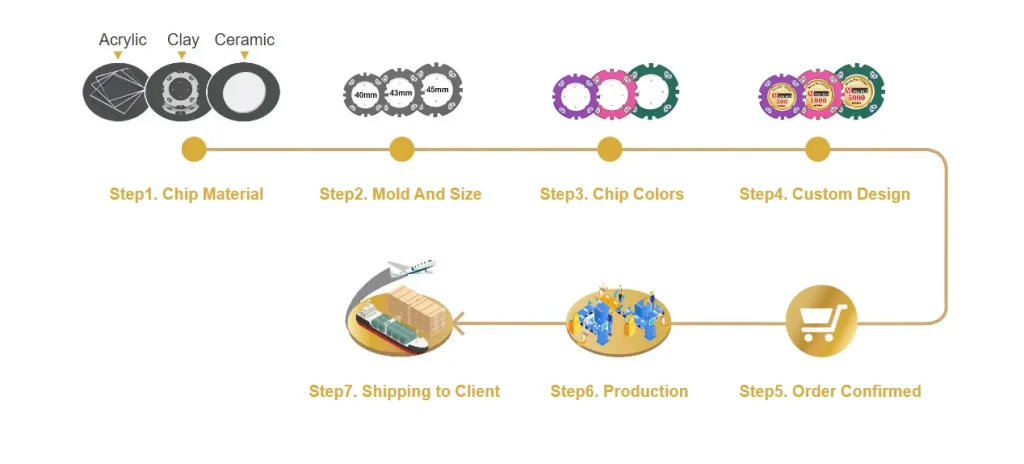
Poker chips are made by molding the chip body, applying the edge spots and inlay, then finishing the surface. Acrylic chips are cut and formed from sheets, clay composite chips are molded under pressure, and ceramic chips are printed across the full face before firing and polishing.
Poker chips may look simple on the table, but behind every finished chip is a precise manufacturing process that balances material science, craftsmanship, and customization. In this article, we take you behind the scenes to explore how acrylic chips, ceramic chips, and clay composite chips are made, how sizes are selected, and what customization options are available for casinos, poker rooms, and gaming brands.
Key Takeaways
- Three materials, three processes. Acrylic chips are cut from sheets and heat-press bonded; clay composite chips are injection-moulded; ceramic chips are printed across the full face by thermal transfer.
- Weight is set by the film stack, not the mould size. A 40 mm acrylic chip ranges from 4.36 mm / 5.55 g bare to 6.73 mm / 6.58 g with films fitted. That range is the main lever for how a chip feels in the hand.
- Security is a materials decision. Iron, copper, or RFID cores can be embedded in composite chips, and RFID inlays are available in acrylic builds, so anti-counterfeiting capability is chosen at specification time rather than added afterwards.
How are acrylic poker chips made?
What Are Acrylic Chips?
Acrylic poker chips are made primarily from high-transparency acrylic material. They are lightweight yet impact-resistant, offering a glass-like appearance with excellent durability. Because of their smooth surface and high gloss, acrylic chips are ideal for intricate designs, vivid colors, and premium branding.
Acrylic chips are widely used in casinos, VIP rooms, and table games, especially for high-denomination or visually distinctive chips.
Acrylic Chip Manufacturing Process
The production of acrylic chips typically follows these steps:
- Injection Molding
Raw acrylic material is heated and injected into molds to form the acrylic base layers. - Layer Preparation
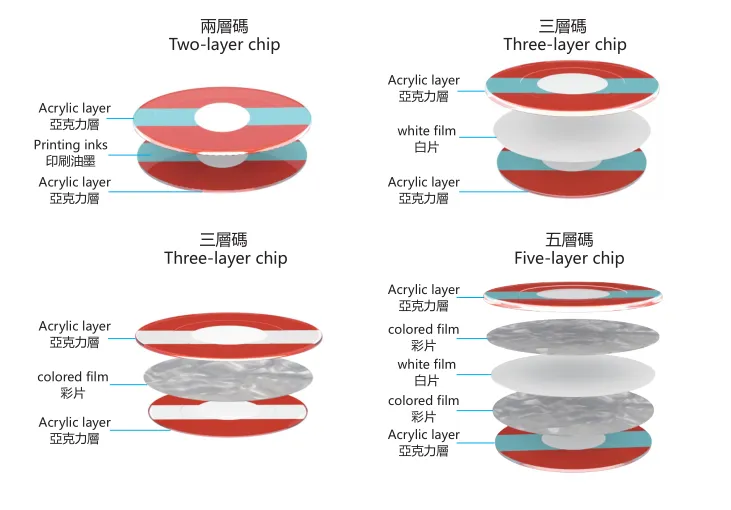
Acrylic chips can be constructed as two-layer, three-layer, five-layer, or RFID-embedded structures. White films, color films, or RFID inlays are prepared for the middle layers. - Pattern Printing
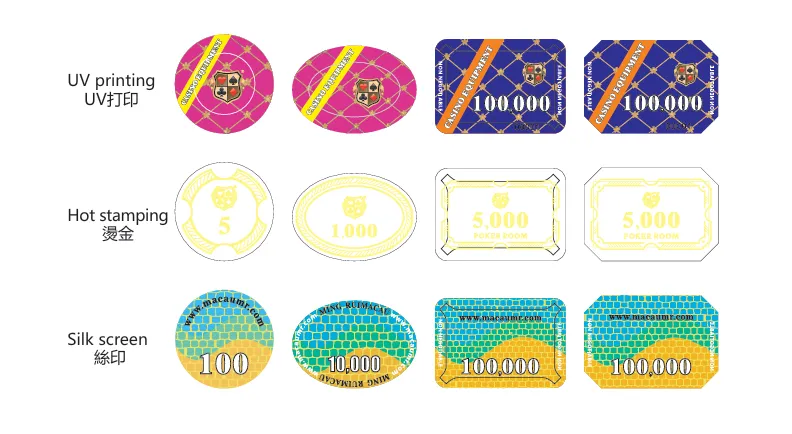
Designs are printed on the reverse side of the acrylic layer using UV printing, silk screen printing, or hot stamping. - Heat Press Bonding
All layers are precisely aligned and bonded together using heat and pressure to ensure structural stability. - Edge Processing & Polishing
Excess edges are trimmed and polished to improve handling and stacking feel. - Surface Cleaning & Packaging
Finished chips are cleaned and packed for shipment.
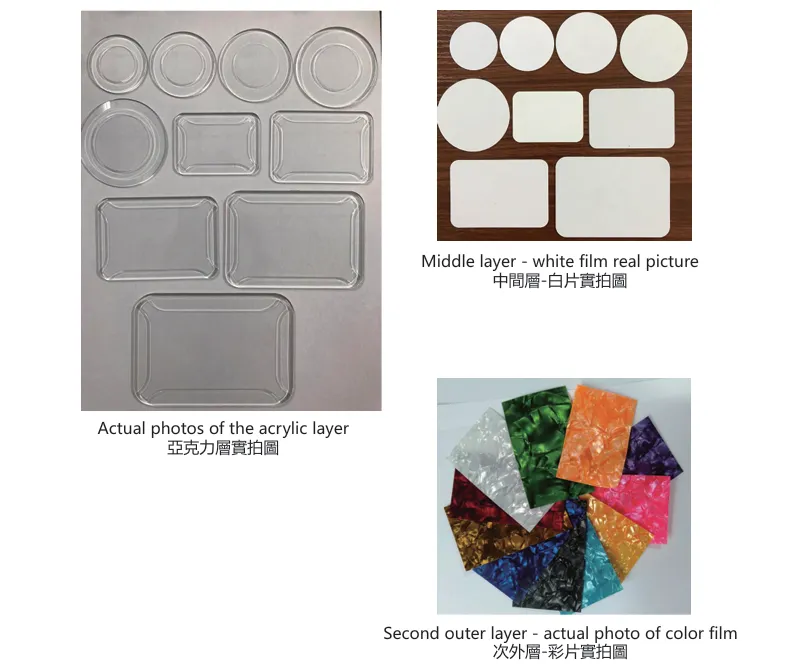
Acrylic Chip Basic Mold Parameters
Thickness/Weight
Note: Values are in mm/g
| Mold Type | Size | No film | 0.9mm white film | 2mm white film | Color film | 0.9mm white film + Color film | 2mm white film + Color film |
|---|---|---|---|---|---|---|---|
| Round mold | 40mm | 4.36mm / 5.55g | 5.32mm / 7.21g | 6.17mm / 8.31g | 5.63mm / 7.79g | 6.56mm / 9.03g | 6.73mm / 6.58g |
| 45mm | 4.42mm / 7.33g | 5.45mm / 9.29g | 6.30mm / 10.83g | 5.31mm / 8.68g | 5.74mm / 10.1g | 6.53mm / 11.24g | |
| 50mm | 4.05mm / 8.4g | 5.34mm / 11.37g | 6.17mm / 12.93g | 5.10mm / 10.74g | 5.64mm / 12.35g | 6.57mm / 14.04g | |
| 55mm | 5.53mm / 14g | 6.61mm / 16.54g | 7.16mm / 19.55g | 6.17mm / 15.87g | 6.75mm / 18.12g | 7.85mm / 20.66g | |
| 60mm | 5.31mm / 14.2g | 6.25mm / 17.49g | 7.06mm / 20.83g | 6.13mm / 17.24g | 6.71mm / 19.86g | 7.75mm / 22.82g | |
| Oval mold | 58×38mm | 4.42mm / 7.56g | 5.52mm / 10.12g | 6.48mm / 11.59g | 4.82mm / 8.65g | 5.52mm / 10.56g | / |
| 68×48mm | 4.37mm / 11.41g | 5.31mm / 11.41g | 6.57mm / 18.34g | 5.01mm / 13.55g | 5.31mm / 15.75g | / | |
| 78×52mm | 4.43mm / 14.79g | 5.32mm / 14.79g | 6.71mm / 23.81g | 5.01mm / 17.36g | 5.32mm / 20.3g | / | |
| Rectangular mold | 58×42mm | 4.63mm / 11.55g | 5.54mm / 14.08g | 6.91mm / 16.17g | 5.48mm / 14.04g | 5.75mm / 15.33g | 6.91mm / 17.72g |
| 69×49mm | 4.35mm / 14.7g | 5.31mm / 19.2g | 6.59mm / 21.38g | 5.06mm / 17.9g | 5.56mm / 20.58g | 6.58mm / 22.94g | |
| 81×56mm | 5.01mm / 22.79g | 5.95mm / 23.39g | 7.19mm / 31.27g | 5.78mm / 26.36g | 6.09mm / 30.03g | 7.19mm / 33g | |
| 94×66mm | 5.61mm / 35.36g | 6.49mm / 42.72g | 7.98mm / 47.1g | 6.42mm / 40.52g | 6.76mm / 45.36g | 7.98mm / 51.08g | |
| 108×78mm | 5.38mm / 44g | 6.37mm / 55.27g | 7.7mm / 60.43g | 6.16mm / 52.62g | 6.47mm / 57.71g | 7.7mm / 63.09g | |
| 118×81mm | 5.66mm / 52.95g | 6.49mm / 62.31g | 7.8mm / 68.92g | 6.46mm / 61.88g | 6.84mm / 68.33g | 7.8mm / 75.71g | |
| Oblique octagonal mold | 68×48mm | 5.14mm / 15.55g | 6.33mm / 20.72g | 6.99mm / 22.8g | 5.84mm / 19.02g | 6.99mm / 21.48g | 7.36mm / 23.86g |
| 82×57mm | 5.39mm / 24.73g | 6.44mm / 31.05g | 7.46mm / 34.44g | 6.04mm / 28.73g | 7.46mm / 32.46g | 7.53mm / 36.26g | |
| 96×67mm | 5.52mm / 33.26g | 6.45mm / 41.74g | 7.09mm / 45.69g | 6.01mm / 38.04g | 7.09mm / 43.66g | 7.43mm / 47.73g | |
| 109×76mm | 5.65mm / 44.03g | 6.46mm / 53.91g | 7.26mm / 59.9g | 6.05mm / 49.96g | 7.26mm / 56.48g | 7.57mm / 62.81g | |
| 118×81mm | / | / | / | / | / | / | |
| Rhombus corner mold | 60×60mm | / | / | / | / | / | / |
| 75×75mm | 5.19mm / 27.7g | 6.14mm / 34.8g | / | 5.93mm / 32.81g | / | / | |
| 89×89mm | 4.44mm / 33.77g | 5.42mm / 43.81g | / | 5.19mm / 41.07g | / | / |
Different thicknesses and internal films affect the final weight, allowing casinos to fine-tune the feel of the chip.
Acrylic Customization Options
- Custom sizes and shapes
- Any denomination or numeric value
- Full-color logos and patterns
- Color film combinations
- UV printing, silk screen printing, or hot stamping
- Optional RFID chip embedding
How are clay composite poker chips molded?
What Are Composite Chips?
Clay composite chips are injection-molded from a blend of clay, plastics, adhesives, and metal or ceramic powders. Iron cores, copper cores, or RFID chips can be embedded to enhance weight, security, and traceability.
These chips are known for their solid weight, excellent grip, and stable stacking, making them a standard choice for professional casinos.
Composite Chip Manufacturing Process
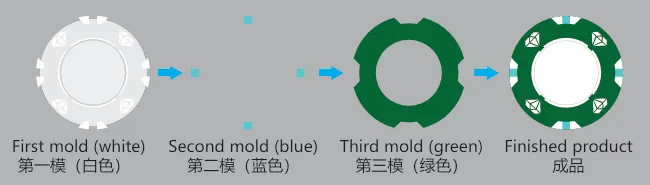
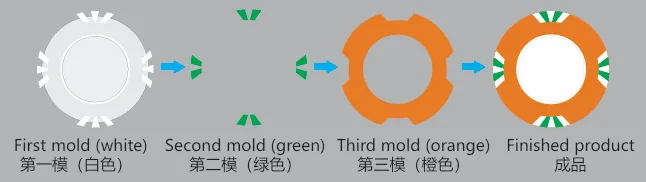
- First Injection Molding
The base material is injected into a mold to form the core chip structure. - Multi-Color Molding
Secondary and tertiary molds are used to add different color rings or edge patterns. - Trimming & Polishing
Chips are trimmed on precision lathes to ensure consistent thickness and roundness. - Center Patch Application
Printed patches displaying denominations, logos, or anti-counterfeiting elements are embedded in the center recess. - Surface Treatment & Packaging
Chips are cleaned and packed after final inspection.
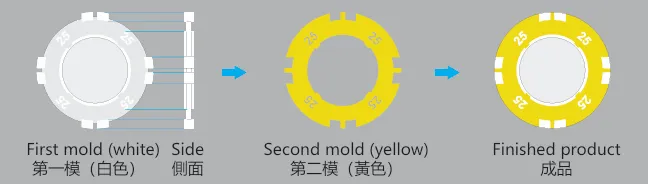
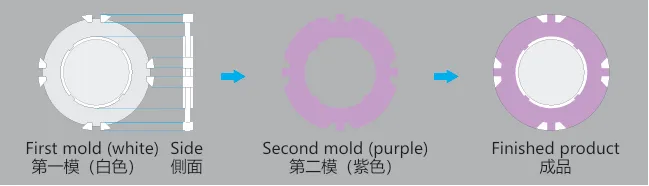
Composite Chip Sizes & Weights
| Diameter | Typical Weight Options |
| 40 mm | 10–14 g |
| 43 mm | 12–15 g |
| 45 mm | 14–16 g |
| 50 mm | 18–22 g |
Weights vary depending on iron core, copper core, or RFID configuration.
Composite Customization Options
- Two-color or three-color structures
- Custom edge spots and inner ring designs
- Printed or molded denominations
- Frosted, glossy, or laser center patches
- Embedded iron, copper, or RFID cores
How are ceramic poker chips printed and finished?
What Are Ceramic Chips?
Ceramic poker chips are made from a pressed mixture of high-density polymer and ceramic powder. Unlike traditional composite chips, ceramic chips allow for full-surface printing through the thermal transfer process., covering the face, back, and edge of the chip.
They are popular in Texas Hold’em clubs and high-end poker rooms due to their modern look and design flexibility.
Ceramic Chip Manufacturing Process
- Substrate Molding
Polymer and ceramic powder are mixed and molded into blank chip bases. - Surface Treatment
Designs are transferred using thermal transfer printing, including edge graphics. - High-Temperature Curing
Heat and pressure permanently bond pigments to the chip surface. - Inspection & Quality Control
Each chip is checked for size, weight, color accuracy, and tolerance.
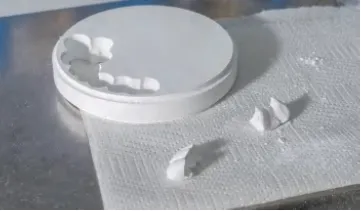
Ceramic Chip Sizes
| Diameter | Typical Weight |
| 39 mm | ~8–10 g |
| 43 mm | ~12 g |
| 46 mm | ~13.5 g |
| 50 mm | ~16 g |
| 55 mm | ~22 g |
Surface options include glossy or textured (linen-like) finishes.
Ceramic Customization Options
- Unlimited colors and gradients
- Photographic-quality graphics
- Full-edge printing
- Custom textures (glossy or fabric feel)
- Any denomination or branding
Which poker chip material should you choose?
| Material | Best For | Key Advantages |
| Acrylic | VIP tables, display-focused games | High gloss, transparency, modern look |
| Composite | Professional casinos | Heavy feel, classic grip, durability |
| Ceramic | Poker clubs, branding-heavy games | Full-print freedom, premium visuals |
FAQ: Common Questions About the Poker Chip
1. What is the main difference between acrylic, ceramic, and clay composite poker chips?
The main differences lie in material composition, feel, appearance, and customization method.
- Acrylic chips are lightweight, glossy, and visually striking, ideal for VIP tables or high-denomination chips.
- Clay composite chips are heavier, offer excellent grip and stackability, and are widely used in professional casinos.
- Ceramic chips allow full-surface printing with unlimited colors and gradients, making them ideal for branding-heavy poker rooms.
2. Which poker chip material feels the heaviest and most “high-end casino”?
Clay composite chips generally provide the heaviest and most traditional casino feel, especially when embedded with iron or copper cores. Their balanced weight and textured surface make them a standard choice for large casinos and gaming halls.
3. Can I customize the size, weight, and denomination of poker chips?
Yes. All three types, acrylic, composite, and ceramic chips, can be customized in terms of:
- Diameter (e.g. 39mm, 40mm, 43mm, 45mm, 50mm, or custom sizes)
- Thickness and weight
- Denomination values
- Logos, text, and design elements
The final weight depends on internal structure, material density, and whether metal cores or RFID chips are used.
4. How are designs and logos applied to poker chips?
Different materials use different printing technologies:
- Acrylic chips use UV printing, silk screen printing, or hot stamping.
- Composite chips typically use molded designs, color rings, and printed center patches.
- Ceramic chips use thermal transfer printing, allowing full-face, edge-to-edge designs with gradients and photographic details.
5. Are poker chips durable enough for long-term casino use?
Yes. All professional poker chips are designed to withstand:
- Repeated stacking and shuffling
- High-frequency handling
- Long-term wear
Composite and ceramic chips are especially durable, while acrylic chips offer excellent impact resistance and surface hardness when properly manufactured.
6. Can poker chips include anti-counterfeiting features?
Absolutely. Depending on the material, poker chips can include:
- RFID chip embedding
- UV markings
- Microtext or laser engraving
- Unique weight distribution
- Serialized hot stamping
These features are commonly used by casinos to improve security and chip traceability.
7. Which poker chip type is best for custom branding and unique designs?
Ceramic poker chips offer the highest level of design freedom, as they support full-surface printing on the face, back, and edge. Acrylic chips are also excellent for high-visual branding, while composite chips focus more on classic casino aesthetics.
8. How do I choose the right poker chip material for my project?
The right choice depends on your use case:
- Choose acrylic chips for visual impact and modern design.
- Choose composite chips for professional casino environments and traditional feel.
- Choose ceramic chips for poker clubs, tournaments, or strong brand identity.
Budget, minimum order quantity, and customization requirements should also be considered.
Conclusion
Behind every poker chip is a carefully engineered process that determines how it looks, feels, and performs on the table. Whether you prefer the crystal-clear elegance of acrylic, the traditional weight of clay composite, or the design freedom of ceramic chips, understanding the manufacturing process helps you choose the right solution for your casino or poker room.
If you are planning a custom RFID poker chip project, material selection, size, weight, and printing method are just as important as the design itself.
What should buyers check before ordering custom poker chips?
The manufacturing process is only half of a chip project. The other half is the specification: material, denomination range, edge spot pattern, inlay artwork and packaging all have to be fixed before production starts, because each one changes the tooling or the print setup.
- Material. Clay composite for a traditional casino weight, ceramic for full-surface print, acrylic for transparent and holographic finishes.
- Denomination ladder. The full range from the lowest working chip to the highest value, with the color scheme for each step.
- Artwork and security. Logo files, inlay design and any anti-counterfeiting or holographic elements.
- Quantity and packaging. Pieces per denomination and how the order is packed for shipment.
How does Macaumr support a custom chip project?
Macaumr manufactures poker chips in Panyu, Guangzhou and has supplied casino operators, distributors and system integrators since 2013 (About Macaumr). Production runs are quoted per project rather than from a fixed list, and the material range is documented in the casino chip materials guide.
Where a floor needs electronic identification, the same factory produces RFID-enabled chips that pair with the casino chip RFID reader range and the SiM Cage management system. The casino chips collection covers clay composite, ceramic, acrylic and RFID options in one place, and each range is documented separately for clay poker chips, ceramic poker chips and acrylic poker chips. A finished example of an RFID order is the RFID clay composite poker chip set.
How do you request chip samples and a quotation?
Send the material, denomination range, artwork and quantity to the Macaumr team. There is no fixed minimum order quantity: the minimum is confirmed per project because it depends on the material, artwork, denomination split and packaging. Production typically takes about one to two weeks after the specification and artwork are approved, and reference samples are available for a non-refundable sample fee.
Talk to the team before the tooling is prepared. Reach Macaumr on WhatsApp at +853 63403801, on Telegram at https://t.me/lym52 or by email at [email protected], or start from the contact page.