

Casino Chips
-

Casino Acrylic Poker Chips3 Products
-
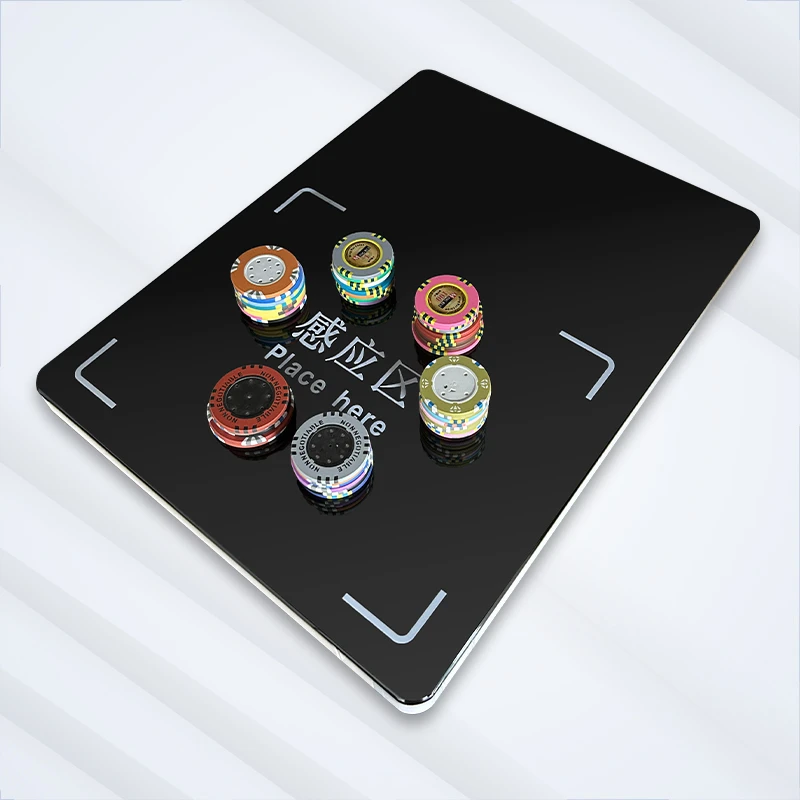
Casino Chip RFID Reader6 Products
-

Casino Ceramic Poker Chips1 Product
-

Clay Poker Chips3 Products
-
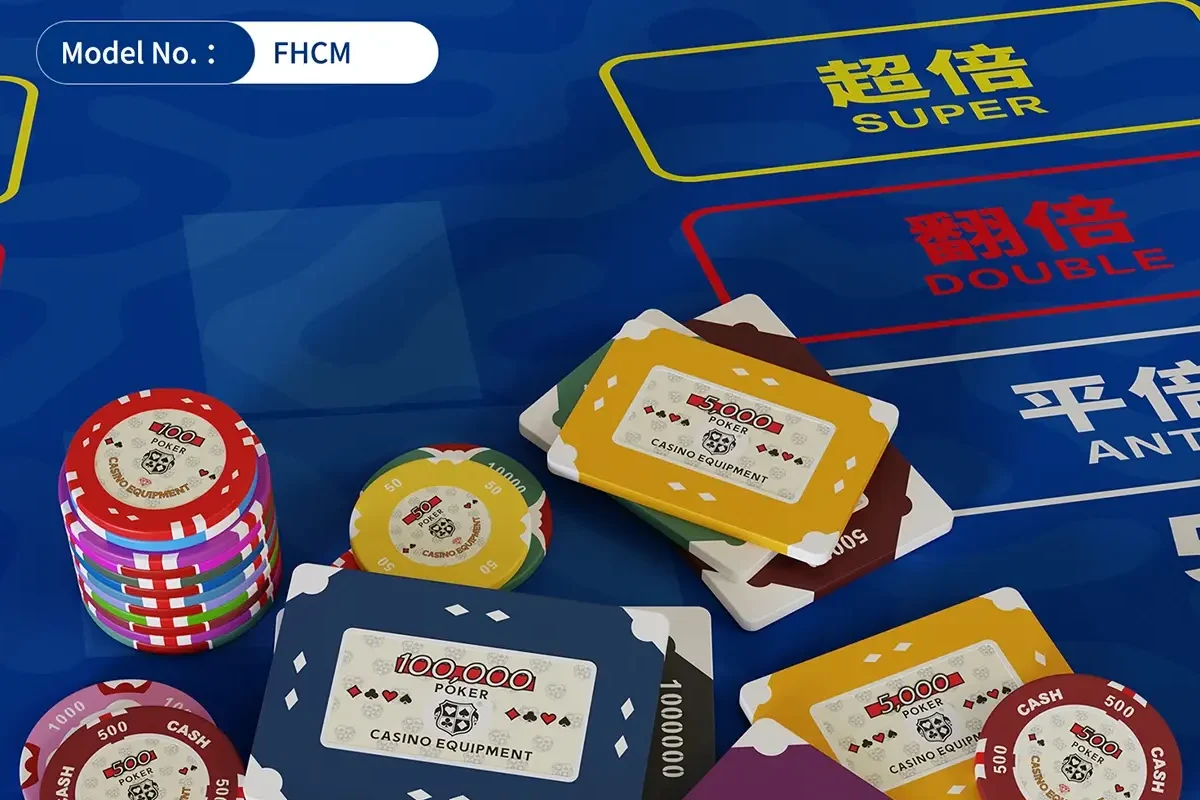
RFID Poker Chips4 Products
A casino chip has to do three jobs at once: carry the denomination clearly, survive years of handling, and resist being copied. Which material you choose settles the first two; the anti-counterfeit specification settles the third. Macaumr builds chips in ceramic, acrylic and clay composite, with RFID available across the range.
Which chip material should you choose?
- Ceramic — heat-transfer printed across the full face, edge to edge, so there is no limit on the design and no gap between the inlay and the body. Smooth and flat in the hand. See ceramic casino chips.
- Acrylic — four-layer lamination producing a crystal translucency. Available as round 39mm chips and rectangular plaques. The most modern presentation, with strong colour saturation. See acrylic casino chips.
- Clay composite — a compression-moulded body around a metal core, giving the classic casino weight and feel with edge spots pressed into the mould rather than printed. See clay composite poker chips.
Most properties specify one material for the main floor and a second for high-limit rooms, where the chip is part of the presentation.
How do you stop chips being counterfeited?
Macaumr offers four anti-counterfeit configurations, and they can be combined on the same chip:
- RFID inlay — an encrypted tag in each chip carrying a unique ID and denomination. Read at the cage and on the floor for real-time authentication and inventory. See RFID poker chips.
- UV ink markings — invisible under normal light and visible under UV, for a fast staff check without equipment.
- Laser-etched serial numbers — a unique serial on the surface or edge, allowing chip-by-chip verification and logging.
- Holographic labels — a visual deterrent that is hard to replicate and quick to verify by eye.
If you are considering RFID, read this first
An RFID chip project only works when the chip, the reader and the cage software are specified as one system. A chip that reads perfectly in a test can still fail once it meets an existing cage workflow, and the failure usually appears after production rather than before it.
Macaumr confirms the whole chain before production: which chip carries which inlay, where the readers sit at the cage and on the floor, and how the data reaches your system. The RFID chip readers include a cage board that authenticates batches of up to 100 chips at the counter and syncs every issue, return, fill and credit, plus a handheld terminal for floor verification. For how chip authentication works in practice, see RFID casino chip authentication.
What is customised on a chip order?
- Denominations — the value structure across the set.
- Colors and edge spots — matched to an existing floor set or designed fresh.
- Inlay and logo — centre artwork carrying the property brand.
- Anti-counterfeit features — any combination of the four options above.
- Denomination colours — the standard colour-to-value mapping your dealers already work to, or a custom scheme.
Ordering casino chips
Send the material, the denomination structure with quantities, the artwork, and any anti-counterfeit requirement. If RFID is involved, send the cage workflow so the reader and software specification can be confirmed. Macaumr issues a quotation with the lead time once the specification is settled.
Reference units are available for a non-refundable sample fee, so weight, feel and print quality can be checked before a full order is placed.
Macaumr has manufactured casino equipment in Panyu, Guangzhou since 2013 and supplies operators, distributors and system integrators across Europe, America, Russia, Japan and South Korea, Southeast Asia, Central Asia, Africa and the Middle East (About Macaumr).
Talk to the team before the chips are specified. Reach Macaumr on WhatsApp at +853 63403801, on Telegram at https://t.me/lym52 or by email at [email protected], or start from the contact page.
Macaumr supplies casino chips in clay composite, ceramic and acrylic constructions, plus RFID-enabled versions for chip identification projects. Each material is produced to order with custom denominations, colors, edge spots and inlay artwork for casino operators, distributors and OEM buyers.
How do you specify a casino chip order?
A chip order goes wrong when the specification is vague. Six decisions define the order, and each one is easier to settle before the artwork is prepared than after production has started.
- Application. A cash-game floor, a tournament set, a VIP room and a promotional run each need a different mix of materials and denominations.
- Material. Clay composite, ceramic or acrylic, chosen for feel, appearance and how the chips are handled during play.
- Denomination range. The full ladder from the lowest working chip to the highest-value plaque, with the color or edge-spot scheme for each step.
- RFID or non-RFID. Whether the chips must be electronically identified, and if so, against which reader and software configuration.
- Artwork and branding. Logo files, inlay design, security print and any holographic or metal-core details.
- Quantity and packaging. Quantities per denomination, plus how the chips are packed for shipment and storage.
Which casino chip material fits your project?
| Material | Character | Common use | Customization |
|---|---|---|---|
| Clay composite | Traditional casino weight with a molded edge | High-volume floor games and tournament sets | Denomination colors, edge spot patterns, logo inlays |
| Ceramic | Rigid, heavy body with a stable stack | Poker rooms and cash games that want a premium feel | Full-color printed designs, denominations, branding |
| Acrylic | Crystal-clear or holographic finish | High-limit rooms, VIP areas and commemorative sets | Transparent and holographic effects, rectangular shapes, metal core |
Material and denominate range are decided together, because the color scheme has to stay readable across the whole ladder. The dedicated categories cover each option in detail: clay poker chips, ceramic poker chips and acrylic poker chips.
When do RFID casino chips make sense?
RFID chips carry an electronic identifier that a compatible reader and software can match to an authorized record. They make sense when a project needs chip identification, verification or inventory tracking rather than a visual check alone: cage reconciliation, pit oversight, shrinkage control and audit trails.
Compatibility is not automatic. Performance depends on the chip frequency and protocol, the reader model, the sensing-zone design, stack conditions, nearby equipment and the receiving system. The RFID poker chips range is produced in ceramic, clay composite and acrylic builds, and Macaumr reviews the complete chip-reader-software workflow before production instead of treating the chip as a standalone item.
For the hardware side, the casino chip RFID reader category covers the cage board, the handheld terminal and table-level reading. The cage chips system covers the accounting software that receives the reading events.
How does the chip ecosystem fit together?
Chips are the part of the system that staff and players actually touch, so they sit in the middle of a wider workflow. At the cage, a reader board authenticates chips during issue, return and count operations. On the floor, RFID gaming tables read the betting positions during play. Between them, the SiM Cage management system records the transactions and reconciles the position.
Buying the chip, the reader and the software from one supplier removes the most common failure point in an RFID project: hardware that is individually correct but never tested as a complete workflow. The casino chip materials guide explains how the constructions differ, and the RFID casino poker chips solution overview covers the tracking side.
What proof does Macaumr offer to buyers?
Macaumr has manufactured casino equipment in Panyu, Guangzhou since 2013 and supplies operators, distributors and system integrators across Europe, America, Russia, Japan and South Korea, Southeast Asia, Central Asia, Africa and the Middle East (About Macaumr).
Two operational figures show how the hardware behaves in service. The Macaumr cage reader board reads up to 100 chips in a batch with a single-chip read time under 0.5 seconds (Casino Cage RFID Chips Reader), and the cage workflow covers six chip operations: issuance, return, destruction, warehousing, fill and credit (SiM Cage management system).
How do you order casino chips from Macaumr?
Send the application, material preference, denomination range, quantity per denomination and artwork files. For RFID projects, include the reader or system model so compatibility can be reviewed with the chip specification. Macaumr then confirms the feasible configuration, the sample process and the commercial terms.
There is no fixed minimum order quantity: the minimum depends on the material, artwork, denomination split, RFID configuration and packaging, and it is confirmed per project. Production typically takes about one to two weeks after the specification and artwork are approved. Existing reference samples are available for a non-refundable sample fee, and fully custom designs are approved from an artwork mock-up before production.
Talk to the team before the chips are specified. Reach Macaumr on WhatsApp at +853 63403801, on Telegram at https://t.me/lym52 or by email at [email protected], or start from the contact page.
Frequently asked questions
What types of casino chips are available?
Macaumr offers casino chips in clay composite, ceramic and acrylic materials, plus RFID-enabled options. Chip customization can include denominations, colors, branding and visual design requirements. Browse the relevant categories to compare options for your project, or send the specification for review before production.
What is the difference between ceramic and clay composite casino chips?
Clay composite chips use a molded edge and traditional casino weight, while ceramic chips have a rigid, heavy body with a stable stack and a premium feel. Both support custom denominations, colors, branding and project-specific visual designs. The most suitable material depends on your project requirements and preferred chip appearance.
Can casino chips be customized with logos and denominations?
Yes. Casino chips can be customized with logos, denomination markings, colors and visual designs, including edge spots and inlay artwork. Customization requirements are reviewed before production so the final specifications can be confirmed for the project, and artwork is approved from a mock-up first.
When should I choose RFID casino chips?
RFID casino chips are suitable when a project requires electronic chip identification within an approved reader and software workflow. Confirm the chip frequency and protocol, reader hardware, reading zones, stack conditions and receiving-system requirements before selecting the configuration, because the chip only works as part of the complete workflow.
What are the disadvantages of RFID casino chips?
RFID projects require compatible chips, readers, sensing-zone design, software integration and acceptance testing. Performance can vary with the selected chip, frequency, stack conditions, nearby equipment and reader configuration, so buyers should validate the complete system rather than the chip alone before committing to a full rollout.
Can RFID casino chips work with an existing cage or management system?
Compatibility depends on the chip frequency and protocol, reader hardware, available identifiers, interface method and the receiving system's data requirements. Provide the system documentation and representative samples so the project configuration and test boundary can be reviewed, and Macaumr will confirm the feasible integration scope in writing.
Which casino chip material is suitable for my project?
The suitable casino chip material depends on your project requirements, customization needs, preferred appearance and whether RFID functionality is required. Macaumr offers clay composite, ceramic and acrylic options that can be reviewed against the project specification, including how the chips are handled and how the denomination colors need to read.
Do you support OEM casino chip projects?
Yes. Macaumr supports OEM and custom casino chip projects for casino operators and gaming equipment distributors. Customization can include branding, denominations, colors, visual designs and project-specific chip specifications. Contact the team to discuss the requirements and the artwork process before production begins.