Casino chip inventory management remains one of the most operationally demanding tasks on a gaming floor. Between high-volume table play, cage transactions, chip fills and credits, and the constant movement between vaults and pits, casinos must account for every token in circulation — or face significant financial exposure. According to the Nevada Gaming Control Board’s 2024 annual report, chip shrinkage — a category covering theft, counterfeiting, and unaccounted loss — costs the industry approximately $40 million annually. RFID-based tracking technology has transformed how modern casinos approach this challenge, replacing manual count sheets with automated, real-time inventory systems. This article explains how casino chip inventory management works with RFID, the audit procedures it enables, and the operational benefits operators gain from deploying these systems across their floors.
Why Casino Chip Inventory Management Matters
Casino chips function as negotiable instruments. A single $5,000 plaque represents real cash value, and a mid-size property may have $20–50 million in chips circulating at any given time. Without rigorous inventory controls, chip shrinkage — the gap between recorded holdings and actual counts — erodes gaming revenue and regulatory compliance.
Traditional inventory methods rely on manual count sheets, periodic cage audits, and visual verification at table openings and closings. These processes are labor-intensive, error-prone, and provide only a retrospective snapshot. A dealer may miscount a tray during a busy shift, a fill may not be logged correctly, or chips may leave the pit without being tracked. By the time a discrepancy surfaces in an end-of-day count, the trail has gone cold.
RFID technology addresses these gaps by embedding a microchip and antenna inside each token, allowing automated detection and identification without line-of-sight scanning. When integrated into a full our RFID chip sensing device collection, every tagged chip becomes a trackable asset, and every reader becomes an accounting checkpoint.
How RFID Casino Chip Tracking Works
Tagged Chips and Embedded Antennas
Each RFID-enabled casino chip contains a passive UHF transponder that complies with the EPC Gen2 (ISO 18000-63) standard. The tag stores a unique electronic product code (EPC) that identifies the chip’s denomination, series, and property code. Tags are embedded during the chip manufacturing process — sandwiched between the core and inlay layers — so they cannot be removed without destroying the chip. For a deeper look at chip construction and tagging, see our guide to RFID casino poker chips.

Reader Infrastructure: Tables, Cages, and Portals
RFID readers are deployed at key checkpoints across the casino floor. Table-embedded readers detect every chip placed on the gaming surface in real time, automatically logging bet values and chip counts during play. Cage readers scan chip trays during fills, credits, and customer buy-ins. Portal readers at doorways track chip movement between restricted zones. The Casino Cage RFID Chips Reader is one such checkpoint device, designed to read stacks of tagged chips in seconds without manual handling.
Central Management Software
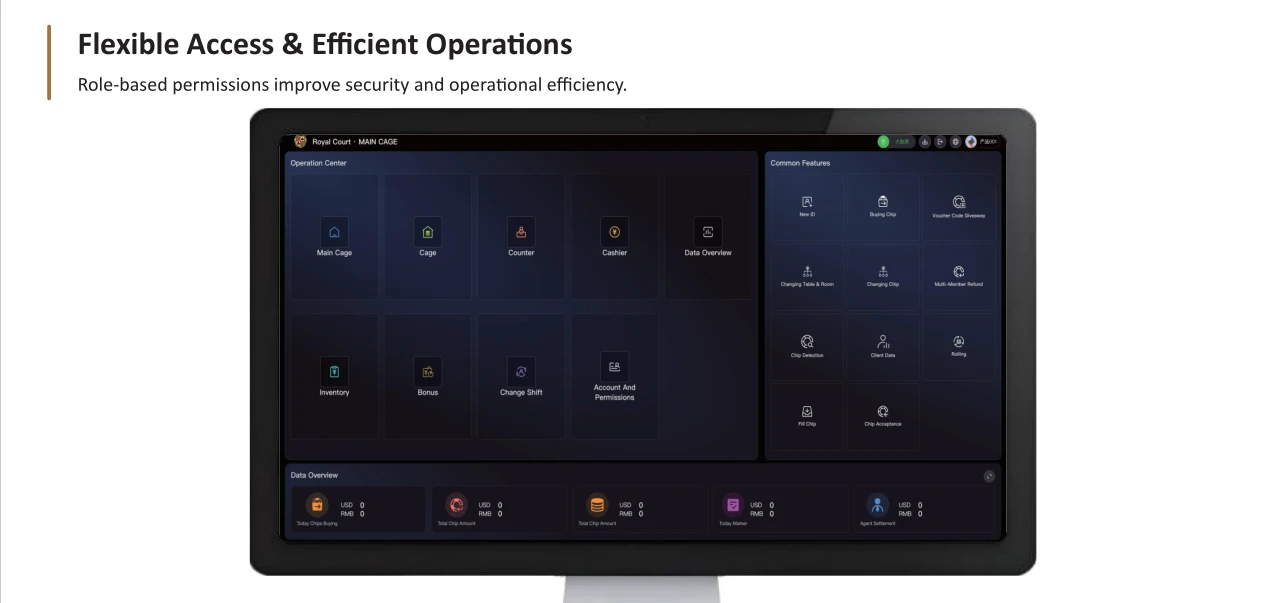
All reader data feeds into a centralized management platform that maintains a live inventory ledger. The SiM Cage Management System exemplifies this architecture, combining cage operations, chip accountability, and role-based access controls into a single dashboard. Operators can view real-time chip positions, generate audit reports, and set automated alerts when thresholds are breached.
Casino Chip Shrinkage: Causes and Prevention
Common Sources of Chip Shrinkage
Chip shrinkage occurs through several vectors:
- Theft by patrons or staff: Chips pocketed during play or removed from unsecured trays account for the largest share of shrinkage losses.
- Counterfeiting: Sophisticated counterfeit chips enter circulation when visual verification is the only safeguard. RFID tags make counterfeiting exponentially harder, since each chip’s EPC must match the property’s encrypted database.
- Clerical errors: Manual fill and credit logs are susceptible to transposition errors, missed entries, and incorrect denominations — all of which create phantom discrepancies.
- Untracked transfers: Chips moved between pits, cages, and vaults without logged handoffs create audit gaps that compound over time.
How RFID Tracking Prevents Each Vector
Against theft, table-embedded readers maintain a running count of every chip on the surface. If chips disappear mid-session — whether removed by hand or hidden beneath layout felt — the system flags the discrepancy within seconds, pinning the alert to the specific table, dealer, and timestamp. Portable scanning devices like the Portable Casino RFID Handheld Terminal let pit managers perform rapid spot checks without disrupting play.
Against counterfeiting, each chip’s EPC is written during production and locked at the factory. A counterfeit chip lacking a valid EPC — or carrying a duplicate code — is immediately rejected by any reader it passes. The system also detects cloned tags by tracking duplicate EPC appearances at physically separate locations simultaneously.
Against clerical errors, automated reader logs eliminate manual data entry entirely. Cage transactions are recorded by the reader at the point of contact, with no opportunity for transposition or omission. Browse our our guide to cage chips system collection for integrated hardware and software solutions designed for this purpose.

Casino Chip Audit Procedures with RFID
Real-Time Continuous Auditing
RFID systems enable a fundamentally different audit model: continuous, real-time verification instead of periodic batch counts. Every chip on every table is accounted for at all times. The system compares the current table inventory (as read by the embedded reader) against the expected balance (opening count plus fills minus credits minus customer cash-outs). Variances trigger immediate alerts rather than waiting for an end-of-shift reconciliation.
Automated End-of-Shift Reconciliation
At shift change, each table’s reader performs a final scan that produces an automated count sheet. This replaces the manual count-and-sign process that typically takes 15–20 minutes per table. With RFID, the same reconciliation completes in under 30 seconds, and the data is immediately available in the management system for supervisor review. The resulting audit trail is tamper-proof — every entry is timestamped, reader-identified, and linked to the operator’s credentials.
Vault-to-Pit Chain of Custody
Every chip movement between vault, cage, and pit is logged as a handoff event. When a fill cart leaves the cage, the portal reader records which chips departed and when. When the cart arrives at the table, the table reader confirms receipt. If any chip fails to appear at the destination within the expected window, the system generates a custody-break alert. This chain-of-custody model satisfies regulatory requirements in jurisdictions that mandate documented chip tracking, including Macau’s DICJ and Nevada’s GCB.
Choosing a Casino Chip Inventory System: Key Evaluation Criteria
Not all RFID inventory systems are created equal. When evaluating a solution for your property, consider the following criteria:
- Read accuracy and speed: The system must read stacked chips reliably — not just individual tokens on a flat surface. Cage and vault readers should scan full chip racks in under 5 seconds.
- Integration with existing infrastructure: Look for solutions that connect to your cage management software, table management system, and surveillance platform through standard APIs. The SiM Cage Management System, for example, integrates reader data with operational workflows out of the box.
- Denomination range support: Ensure the system covers your full denomination range — from $1 blanks to $100,000 plaques — with consistent read performance across all form factors.
- Regulatory compliance reporting: The platform should generate audit-ready reports that meet local gaming commission requirements without manual formatting or data export.
- Scalability: A property with 50 tables needs a different architecture than one with 500. Choose a system that scales horizontally by adding reader nodes without requiring a central server upgrade.
For operators planning a full-floor deployment, browse our casino chips collection to explore tagged chip options. For a broader perspective on how RFID transforms table-level operations, see our article on how RFID chip tray technology prevents theft and accelerates table accounting.
Frequently Asked Questions
What is casino chip inventory management?
Casino chip inventory management is the process of tracking, counting, and accounting for every gaming chip on a casino floor — from vault storage through cage transactions to table play. Modern systems use RFID technology to automate this process, replacing manual count sheets with real-time digital ledgers that log every chip movement.
How does RFID prevent casino chip shrinkage?
RFID prevents chip shrinkage by embedding a unique electronic tag in each chip that readers can detect automatically. Table readers flag missing chips within seconds, cage readers log every transaction without manual entry, and portal readers track chip movement between zones — closing the audit gaps where theft, counterfeiting, and clerical errors typically occur.
How accurate are RFID casino chip tracking systems?
Modern RFID chip tracking systems achieve read accuracy rates above 99.5% for stacked chips in trays and near 100% for chips on table surfaces. Accuracy depends on reader placement, antenna tuning, and chip density — but properly calibrated systems consistently outperform manual counting in both speed and reliability, as documented in testing by the Gaming Laboratories International (GLI) standards for RFID gaming equipment.
What regulations require casino chip tracking?
Jurisdictions including Nevada (Nevada Gaming Control Board Regulation 12), Macau (DICJ Administrative Regulation 16/2012), and Singapore (Casino Regulatory Authority guidelines) mandate documented chip accountability procedures. While RFID is not universally required, it is the preferred compliance method because its automated, tamper-proof audit trails satisfy regulatory documentation requirements with less labor and higher reliability than manual processes.