Casino surveillance has evolved far beyond the era of grainy CCTV feeds and manual observation. In 2026, smart camera systems paired with AI analytics are redefining how casinos protect revenue, detect cheating, and maintain operational integrity across the gaming floor. This guide breaks down the core technologies, implementation strategies, and measurable ROI that modern surveillance delivers for casino operators.
Why Traditional Casino Surveillance Falls Short
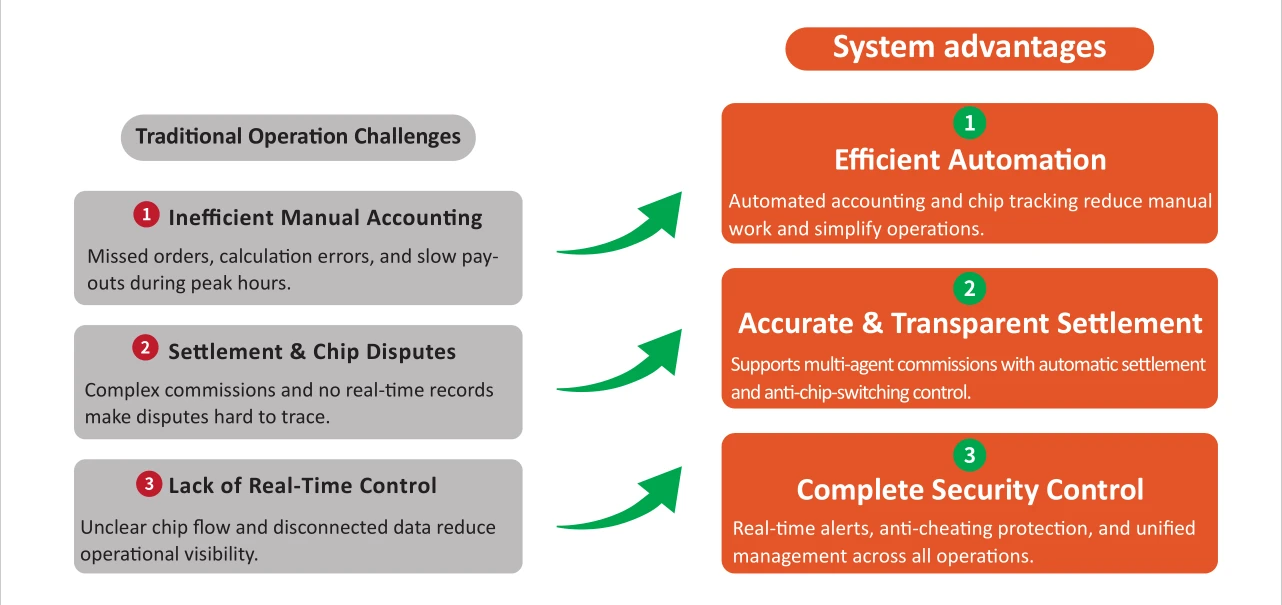
Conventional surveillance relies on passive recording and human monitoring. Pit bosses and surveillance officers manually scan dozens of camera feeds, trying to catch irregularities in real time. This approach has critical weaknesses:
- Attention fatigue: Studies show human observers miss up to 45% of critical events after 20 minutes of continuous monitoring.
- Reactive rather than proactive: Traditional systems record incidents for after-the-fact review, not real-time prevention.
- Scalability limits: Adding more tables means adding more screens and staff, driving up costs without proportional gains in coverage.
- Integration gaps: Standalone cameras cannot communicate with chip tracking, card shufflers, or table management systems.
Core Components of Smart Casino Surveillance Systems
AI-Powered Video Analytics
Modern casino cameras do more than record — they analyze. AI-driven video analytics process every frame in real time, flagging suspicious behavior patterns that human eyes would miss. Key capabilities include:
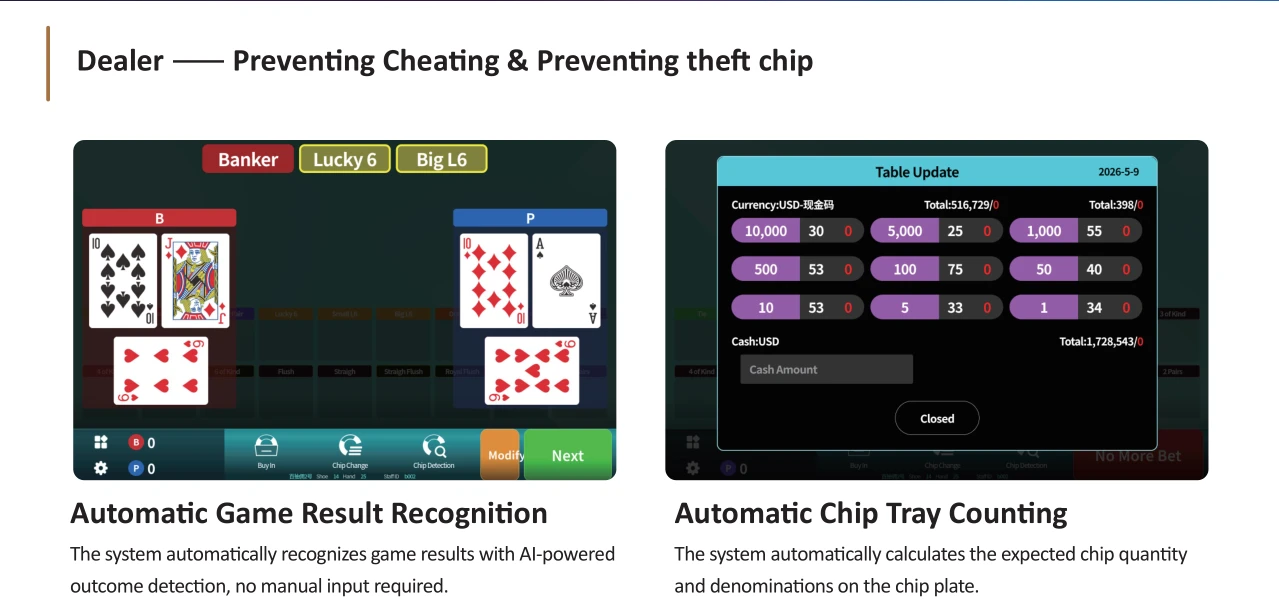
- Card tracking: Optical recognition identifies every card dealt, comparing against expected outcomes to detect marked cards or dealer collusion.
- Chip movement detection: Algorithms track chip positions across the table, alerting when chips move outside normal transaction patterns.
- Behavioral anomaly scoring: Machine learning models flag players whose betting patterns, hand gestures, or timing deviate from statistical norms.
RFID Integration with Surveillance
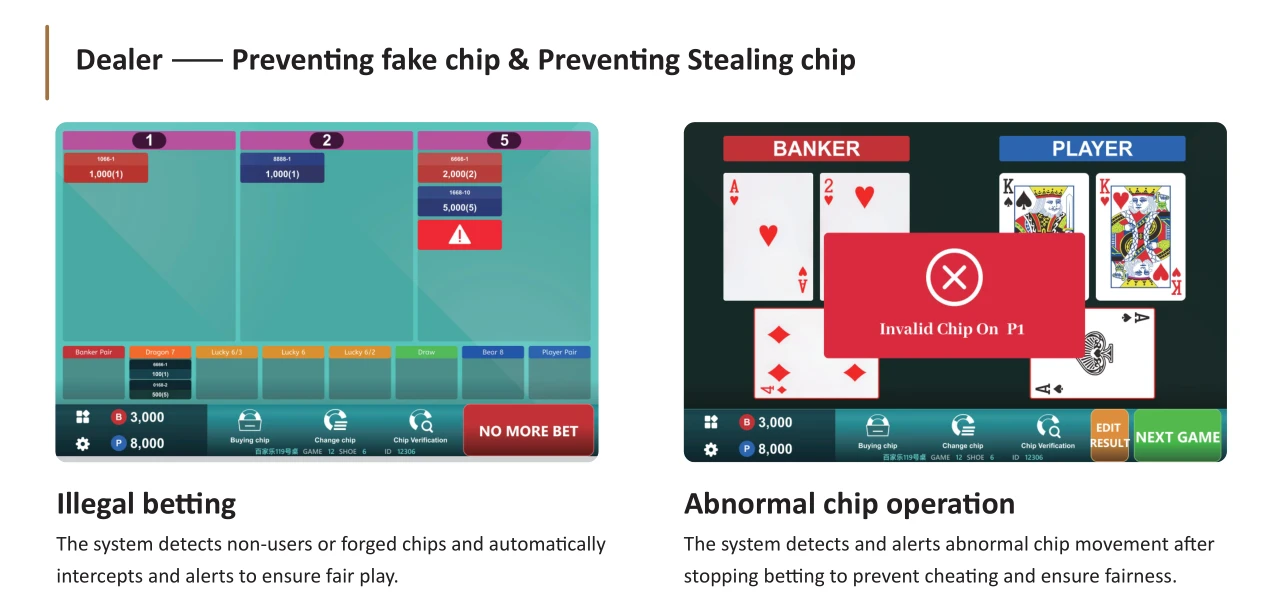
When RFID-enabled tables communicate with surveillance cameras, the system gains a powerful second layer of verification. RFID readers embedded in the table track every chip by denomination and serial number, while cameras verify the physical context. For example, if an RFID reader detects a high-value chip that the camera did not observe being placed as a bet, the system instantly flags a potential RFID chip sensing anomaly. This dual-layer approach closes the gap that either technology alone would leave open.
Casinos that deploy the SiM Cage Management System extend this protection into the cage, where RFID tracking reconciles chip inventories against surveillance records in real time.
Real-Time Dashboards and Alert Systems
Smart surveillance feeds data into centralized dashboards that give pit managers and security teams an operational overview at a glance. Key features include:
- Win/loss trend monitoring: Track table performance and detect statistical deviations that suggest advantage play or collusion.
- Instant alerts: Push notifications for suspicious events — fake chip detection, over-table-limit bets, payout errors — enabling rapid response.
- Historical replay with analytics overlay: Review any incident with AI-annotated markers showing exactly when and where anomalies occurred.
How AI Analytics Detect Cheating Patterns
AI analytics excel at identifying patterns invisible to human observers. Here is how the technology catches specific cheating methods:
Advantage Play Detection
Card counters and advantage players rely on betting variations that correlate with deck composition. AI systems track every bet size and timing, comparing against mathematical models to flag statistical outliers. When a player’s bet spread exceeds expected variance over a defined sample size, the system alerts the pit — long before a human could detect the pattern.
Dealer Collusion and Past Posting
AI cameras monitor dealer hand movements with millisecond precision. The system flags irregularities such as a dealer’s hand hovering over the shoe longer than normal (suggesting a second deal) or chips appearing on a betting spot after the outcome is known (past posting). These micro-behavioral signals are nearly impossible for manual observation to catch consistently.
Counterfeit Chip Identification
When combined with RFID chip sensing devices, surveillance cameras add visual verification to electronic authentication. If a chip lacks a valid RFID signature, the camera system zooms in on the specific chip location, captures high-resolution imagery, and cross-references the chip’s physical appearance against a known-authentic database. For operators looking to upgrade their chip security, browse our casino chips collection for RFID-enabled and holographic options.
ROI of Smart Surveillance: The Numbers Behind the Investment
Deploying AI-powered surveillance requires capital investment, but the return is measurable and significant. Based on operational data from casinos that have upgraded:
- Cheating loss reduction: AI surveillance reduces cheating-related losses by 60–80% within the first year of deployment.
- Staff efficiency: Automated alert systems reduce the surveillance team’s manual review workload by 40%, allowing smaller teams to cover more tables.
- Dispute resolution: AI-annotated video evidence resolves 90% of player disputes within minutes instead of hours of manual review.
- Compliance readiness: Automated logging and reporting cut audit preparation time by 50% and eliminate gaps that regulators flag.
For a deeper look at how technology integration drives operational ROI, see our article on casino cage management system ROI.
Implementation Roadmap for Casino Operators
Phase 1: Assessment and Infrastructure Audit
Begin by mapping every camera position, identifying blind spots, and evaluating existing network bandwidth. Legacy analog cameras need replacement with IP-based units that support AI processing. Assess whether your current roadmap display systems can integrate with the new surveillance backbone.
Phase 2: Camera Upgrade and Network Buildout
Deploy high-resolution IP cameras with on-edge AI processing capability. Position cameras for full table coverage with overlapping fields of view. Ensure the network infrastructure supports the data throughput — a typical smart camera generates 4–8 Mbps of analytics data per table.
Phase 3: AI Model Training and Integration
Train AI models on your specific table layouts, chip designs, and card types. Integration with existing systems — RFID tables, electronic shoes, and cage management — creates the multi-layer verification architecture that maximizes detection accuracy. For insights on how electronic shoes contribute to game integrity, read our guide to baccarat electronic shoe anti-fraud technology.
Phase 4: Testing, Calibration, and Go-Live
Run parallel operations for 4–6 weeks with both old and new systems active. Calibrate alert thresholds to minimize false positives while maintaining detection sensitivity. Train surveillance staff on the new dashboard interface before cutting over to the AI-driven system.
Common Mistakes When Upgrading Casino Surveillance
- Skipping the network audit: AI cameras require robust bandwidth. Deploying smart cameras on a congested network leads to dropped frames and missed alerts.
- Over-reliance on AI without human oversight: AI is a tool, not a replacement. The most effective systems pair automated detection with trained analysts who can interpret context.
- Ignoring integration potential: Standalone surveillance delivers limited value. Connecting cameras with the DY10 Roulette Display with Integrated Camera or other smart table hardware multiplies the detection capability.
- Underestimating staff training: New dashboards and alert protocols require deliberate training. Casinos that skip this step see low adoption and frequent alert dismissals.
Frequently Asked Questions
How much does a smart casino surveillance system cost?
A full AI-powered surveillance upgrade for a mid-size casino (40–60 tables) typically ranges from $200,000 to $500,000, including cameras, servers, AI software licensing, and installation. Most operators recoup the investment within 12–18 months through reduced cheating losses and operational efficiency gains.
Can AI surveillance replace human surveillance staff?
No. AI surveillance augments human teams rather than replacing them. The technology handles continuous monitoring and pattern detection, while trained analysts provide contextual judgment, investigate flagged events, and make operational decisions. The most effective casinos use AI to make their existing teams more productive.
How does AI surveillance handle player privacy concerns?
Casino surveillance operates under strict regulatory frameworks that govern data collection, retention, and access. AI systems can be configured to blur faces in non-essential footage, restrict access to analytics data by role, and automatically purge footage beyond required retention periods. Compliance with local gaming commission regulations is built into deployment planning.
What is the detection accuracy of AI casino surveillance?
Modern AI surveillance systems achieve 95–99% accuracy in detecting known cheating patterns (past posting, chip manipulation, card marking) when properly calibrated. False positive rates typically fall below 2% after the initial training period. Accuracy improves over time as the system learns the specific behavioral patterns of each casino’s players and dealers.
How long does implementation take?
A complete smart surveillance deployment — from infrastructure audit to go-live — typically takes 3–6 months for a mid-size operation. This includes 4–6 weeks of parallel operation to calibrate AI models and train staff before the legacy system is decommissioned.