Why Casino Chip Holographic Labels Matter for Floor Security
Casino chip holographic labels serve as the first visual barrier against counterfeit chips on the gaming floor. Unlike plain inlay designs, holographic labels embed multi-dimensional optical patterns that shift color and shape under different viewing angles, making replication prohibitively expensive for would-be counterfeiters. According to the Nevada Gaming Control Board’s 2024 annual report, counterfeit chip incidents declined by 34% in properties that adopted multi-layer holographic labeling compared to those relying solely on UV ink markings.
For casino operators evaluating chip procurement, understanding how holographic labels work—and how they integrate with broader anti-counterfeiting systems—is essential. A chip that passes visual inspection but fails under holographic verification exposes the house to direct revenue loss and regulatory scrutiny. The browse our clay poker chips collection to see examples of chips equipped with holographic inlays designed for high-security environments.

How Holographic Labels Work: Optical Physics Behind the Security
A holographic label on a casino chip is not a simple sticker. It is a diffractive optical element created through laser interference pattern recording. When coherent laser light hits a photoresist surface, it creates microscopic grooves—typically 600 to 2,000 lines per millimeter—that diffract incident light into specific patterns. The result is an image that appears to move, change color, or display hidden text when the viewing angle shifts.
This optical behavior is governed by the ISO 14298 standard for security printing management, which specifies process controls for the creation and handling of diffractive optically variable image devices (DOVIDs). Casinos that source chips compliant with ISO 14298 gain two advantages: assurance that the hologram production process itself is audited, and a verifiable chain of custody from design master to finished label.
Modern holographic labels on gaming chips typically combine three layers of optical features:
- Kinetic movement — visual elements that appear to animate when the chip is tilted, confirming authenticity through motion
- Color-shifting — wavelength-dependent color changes visible under ambient lighting, no special equipment required
- Covert microtext — text or symbols visible only under 10× magnification, providing a forensic-level verification step
Each layer independently raises the cost and complexity of counterfeiting. Combined, they create what security engineers call a “defense-in-depth” optical barrier. The Casino Baccarat Game Customizable Composite Poker Chips with Holographic Labels demonstrate this layered approach, combining kinetic holographic inlays with UV-reactive ink as a secondary verification channel.
Holographic Labels vs Other Anti-Counterfeiting Methods
Casinos have several anti-counterfeiting options for chip security. Understanding where holographic labels fit within the full spectrum helps operators make informed procurement decisions.

UV Ink Markings
UV-fluorescent ink is the most affordable anti-counterfeiting feature. It costs approximately $0.02 per chip to apply and requires only a UV lamp for verification. However, UV ink is increasingly vulnerable—commercial UV printers capable of reproducing visible-range fluorescence are available for under $500. UV ink is best treated as a secondary layer, not a standalone solution.
RFID Embedded Tags
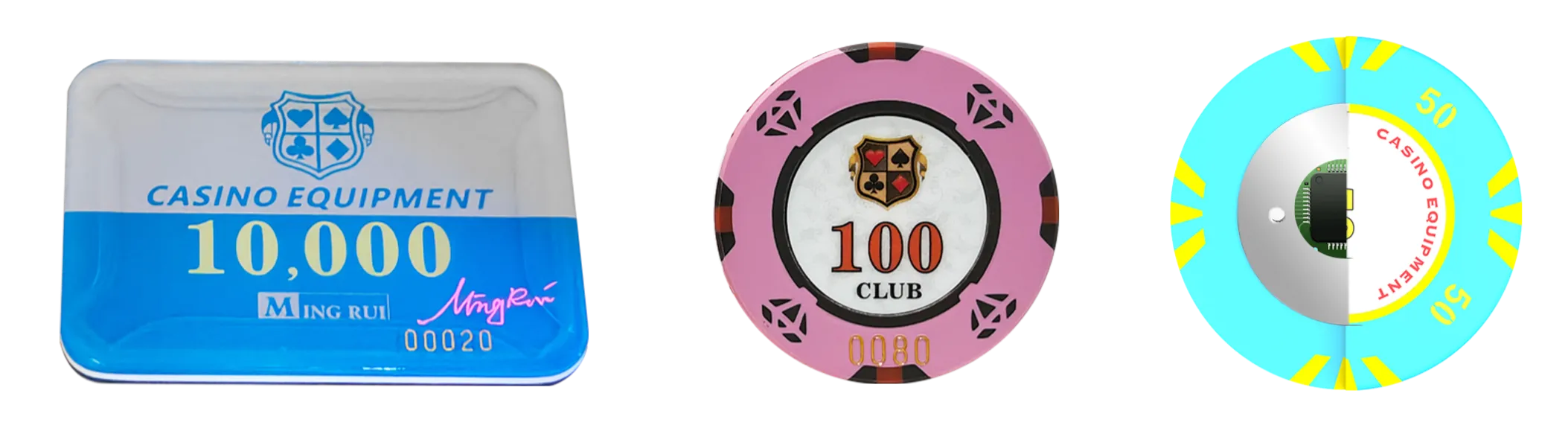
RFID inlays embedded within chip cores provide electronic authentication that is extremely difficult to clone. Each tag carries a unique identifier readable by the Casino Cage RFID Chips Reader or the Portable Casino RFID Chips Anti-Counterfeit Handheld Terminal. RFID adds $1.50 to $3.00 per chip but enables automated real-time tracking. For a detailed look at how RFID scanning integrates with chip verification workflows, see our guide to RFID casino chip sensing devices and real-time detection.
Hot Stamping
Hot stamping applies metallic foil to the chip surface using heat and pressure. It adds a tactile and visual element that is moderately difficult to replicate. However, hot stamping alone provides limited security—it lacks the dynamic optical behavior of holograms and carries no electronic data.
Holographic Labels (Recommended Baseline)
Holographic labels occupy the optimal middle ground: they cost $0.15 to $0.50 per chip, require no electronic infrastructure for verification, and provide multi-layer optical security that is significantly harder to replicate than UV ink or hot stamping. For operators not yet ready to invest in full RFID infrastructure, holographic labels deliver the highest security-per-dollar ratio.
Implementing Holographic Labels: Specification and Procurement Guide
When specifying holographic labels for casino chips, operators should define the following parameters during procurement:
Label Size and Placement
Standard casino chip holographic labels are 20mm to 25mm in diameter for round inlays, placed on the chip center (inlay area). Rectangular labels (18mm × 36mm) can be applied as edge bands. The label must sit flush with the chip surface to prevent peeling during handling or stacking.
Optical Feature Complexity
Specify at minimum two optical channels: one overt (visible kinetic movement) and one covert (microtext or laser-engraved serial numbers). Three-channel labels adding a color-shifting element are recommended for denominations above $100. The browse our RFID chip sensing device collection for readers that can complement holographic verification with electronic authentication.
Adhesive Durability
The label adhesive must withstand repeated handling, cleaning solvents, and temperature fluctuations from 0°C to 60°C. Request adhesive test reports compliant with ASTM D3330 (peel adhesion) and ASTM D3653 (shear adhesion) from your chip supplier.
Master Origination Security
The holographic master shim—the original laser-recorded template from which all labels are replicated—must be stored under controlled access. Require your supplier to certify ISO 14298 compliance and provide a certificate of origination that limits production to your authorized order quantity only.
Integrating Holographic Labels with RFID Chip Tracking
The most robust casino chip security strategy combines optical and electronic authentication. Holographic labels provide instant visual verification at the table level—dealers and floor supervisors can spot fakes during routine observation without equipment. RFID provides automated electronic verification at the cage and during chip counts. Together, they cover every point in the chip lifecycle.
Implementation sequence matters. Operators deploying holographic labels first can later add RFID inlays without replacing the labels—the RFID tag sits in the chip core, separate from the surface hologram. This phased approach spreads capital expenditure across budget cycles. For operators already running RFID systems, holographic labels add a redundant human-verifiable layer that catches chips with cloned RFID tags but poor optical reproduction. To understand the financial case for this integration, see our article on the risks of fake casino chips.
The browse our acrylic chips collection showcases chips available with holographic label options, suitable for both standalone visual security and RFID-integrated configurations.
Frequently Asked Questions
What is a holographic label on a casino chip?
A holographic label on a casino chip is a diffractive optical security element applied to the chip surface that displays color-shifting and kinetic patterns when viewed from different angles, making visual counterfeiting extremely difficult.
How much do holographic labels add to chip cost?
Holographic labels add approximately $0.15 to $0.50 per chip, depending on optical feature complexity and order volume. This is significantly less than RFID inlays ($1.50–$3.00 per chip) while providing strong visual-level security.
Can holographic labels be combined with RFID?
Yes, holographic labels and RFID inlays are fully compatible. The holographic label sits on the chip surface while the RFID tag is embedded in the core, allowing both visual and electronic authentication to operate simultaneously.
How do I verify a holographic label is authentic?
Tilt the chip under ambient light and observe kinetic movement and color shifts. For forensic verification, examine microtext under 10× magnification. These checks require no electronic equipment, making holographic labels ideal for table-level security.
Are holographic labels sufficient as a standalone anti-counterfeiting measure?
Holographic labels provide strong baseline security for most operations. However, for high-denomination chips or properties with significant counterfeit risk, combining holographic labels with RFID tracking delivers defense-in-depth protection as recommended by the Nevada Gaming Control Board’s 2024 security guidelines.