Casino Playing Cards: A B2B Buying Guide to Materials, Customization, and Quality Standards
Casino playing cards are the most handled, most scrutinized, and most frequently replaced consumable on any gaming floor. A single baccarat table running 24 hours can cycle through 8–12 decks per day, and a 40-table pit will burn through over 10,000 decks annually. For casino operators and procurement managers, choosing the right playing cards is not a trivial purchasing decision—it directly affects game integrity, dealer efficiency, and per-table operating costs.
This guide breaks down the materials, manufacturing processes, and customization options that distinguish casino-grade playing cards from retail-grade alternatives. Whether you are outfitting a new VIP room or optimizing procurement for an established property, the specifications below will help you evaluate suppliers on objective quality criteria rather than marketing claims.
We will also examine how card material selection interacts with anti-counterfeiting requirements, regulatory compliance, and total cost of ownership—three factors that B2B buyers consistently rank as their top concerns when sourcing casino playing cards from specialized manufacturers.
Casino Playing Cards: Core Material Types and Specifications
The material composition of casino playing cards determines three critical performance metrics: opacity (resistance to light-based cheating), durability (deck lifespan under continuous dealing), and handling characteristics (flex, snap, and slide). There are two primary material categories used in professional casino environments: paper-based cards and plastic-based cards.
Paper-based cards remain the industry standard for baccarat and blackjack pits in major gaming jurisdictions. The key differentiator is the core construction. Casino-grade paper cards use a black or blue core layer sandwiched between two outer print layers. This opaque core prevents light transmission—a critical anti-cheating measure that prevents players or dealers from identifying cards held up to overhead lighting. The three main paper core specifications are:
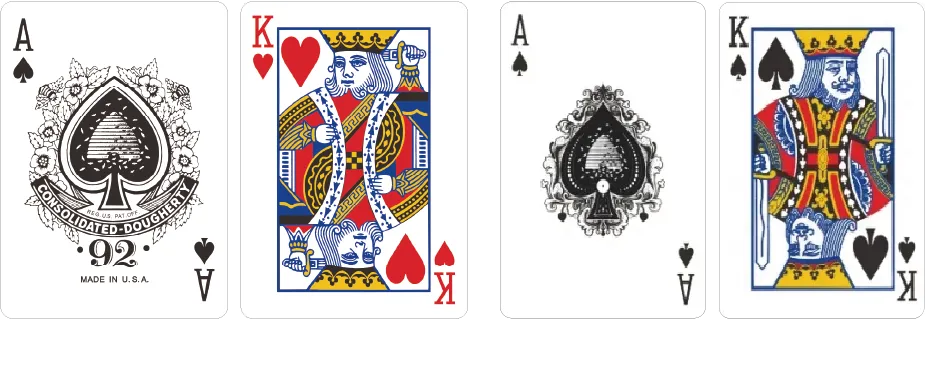
- German Black Core Paper (310g): The premium tier, manufactured by specialized European mills. Offers the highest opacity rating (99.2% light blockage at 310gsm), superior snap, and consistent flex across temperature and humidity ranges. Used in Macau VIP rooms and Las Vegas high-limit pits. The German black core paper playing cards we supply are sourced directly from these mills and configured for custom face designs.
- Korean Black Core Paper (300g): A mid-tier option balancing cost and performance. Korean black core stock achieves 97.5% opacity at 300gsm and is widely used in mid-range casino operations across Southeast Asia. It offers good durability (typically 6–8 hours of continuous play per deck) and accepts offset printing well.
- China Blue Core Paper (280g): An entry-level casino-grade option. The blue core provides 94% opacity at 280gsm—sufficient for low-stakes tables and training environments. While not suitable for VIP operations, blue core cards meet minimum regulatory opacity standards in most jurisdictions and offer significant cost savings for high-volume operations.

Plastic-based cards represent a smaller but growing segment, particularly in poker rooms and casual gaming areas. 100% PVC plastic cards offer waterproof performance, significantly longer deck life (20–30 hours of continuous use), and washability. However, plastic cards have lower opacity than black core paper and are generally not approved for high-stakes baccarat in jurisdictions with strict gaming commission standards. For poker rooms and club environments, our plastic waterproof playing cards provide a cost-effective solution with full customization of faces, backs, and packaging.
Paper vs Plastic Playing Cards: Operational Cost Comparison
The choice between paper and plastic playing cards is fundamentally a total-cost-of-ownership calculation. According to a 2024 industry analysis by the American Gaming Association, table games operations spend an average of $0.85–$1.20 per deck on paper cards and $3.50–$5.00 per deck on plastic cards. However, the per-deck cost tells only part of the story.
Paper cards typically last one shift (6–8 hours) in a high-traffic baccarat pit before showing edge wear, corner fraying, or ink degradation that triggers regulatory replacement requirements. Plastic cards can last 3–5 times longer under similar conditions. For a 20-table baccarat pit running 24/7 with 8-deck shoes:
| Cost Factor | Paper (German Black Core) | Plastic (100% PVC) |
|---|---|---|
| Cost per deck | $1.10 | $4.20 |
| Deck life (continuous play) | 6–8 hours | 24–30 hours |
| Decks per table per day | 12 | 4 |
| Daily cost per table | $13.20 | $16.80 |
| Annual cost per 20-table pit | $96,360 | $122,640 |
While plastic cards appear more expensive on a per-deck basis, the gap narrows significantly when factoring in deck life. However, regulatory requirements in many jurisdictions (including Macau’s Gaming Inspection and Coordination Bureau) mandate paper cards for baccarat and blackjack, making plastic cards viable only for poker rooms and non-regulated table games.
Custom Casino Playing Cards: Manufacturing and Printing Standards
Custom casino playing cards require manufacturing precision that goes far beyond retail card production. The production process involves five critical stages, each of which impacts the final product’s regulatory compliance and operational performance.
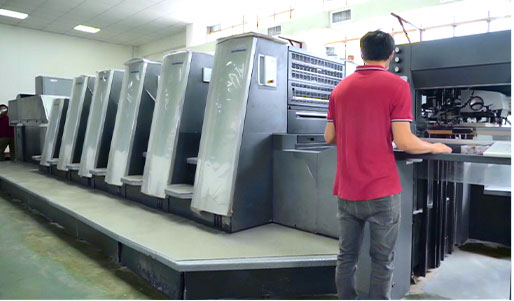
Stage 1: Core Sheet Production. The opaque core layer is manufactured through a specialized papermaking process that distributes carbon black or blue pigment evenly throughout the sheet. Inconsistent distribution creates translucency hotspots—areas where cards can be read through the back when held against light. Quality manufacturers use Heidelberg printing technology and spectrophotometric inspection to verify opacity uniformity across every sheet.
Stage 2: Offset Printing. Card faces and backs are printed using sheet-fed offset lithography, which delivers the color consistency and fine-line registration required for casino-grade graphics. Casino logos, custom suit designs, and security patterns must register within 0.1mm tolerance across all 54 cards in a deck. Digital printing, while cheaper, cannot achieve the ink density or edge definition required for anti-counterfeiting features.
Stage 3: UV Varnishing and Coating. After printing, cards receive a UV-cured varnish coating that controls slip and wear characteristics. The varnish formulation determines how cards slide across felt, how they fan in a dealer’s hand, and how resistant they are to fingertip oils. Casino-specific varnish formulations typically achieve a coefficient of friction between 0.35 and 0.45 on felt—a range that balances dealing speed with card control.
Stage 4: Collating and Cutting. Cards are collated into sequential decks and cut using precision steel rule dies. Cut tolerance of ±0.2mm ensures uniform card dimensions, which is essential for shuffle machine compatibility and dealing shoe performance. Inconsistent card dimensions cause jams in automatic shufflers and can produce detectable edge patterns that advantage players.
Stage 5: Quality Inspection. Each deck undergoes visual and automated inspection for print defects, registration errors, and dimensional consistency. Reputable manufacturers maintain AQL (Acceptance Quality Limit) standards of 1.5 or tighter for major defects. For a deeper look at how anti-counterfeiting features are integrated into this process, see our article on casino playing card security and anti-counterfeiting technology.
Casino Grade Playing Card Materials: Regulatory and Compliance Requirements
Gaming regulators in major jurisdictions impose specific technical requirements on playing cards used in licensed operations. These requirements are not uniform—procurement managers must verify that their card specifications meet the standards of every jurisdiction where the cards will be used.
In Macau, the Gaming Inspection and Coordination Bureau (DICJ) mandates that all playing cards used in licensed casino operations must achieve minimum opacity standards, be sourced from approved suppliers, and carry serialized identification for traceability. The Nevada Gaming Control Board (NGCB) similarly requires that playing cards meet specific dimensional tolerances (63mm × 88mm ± 0.5mm for poker size) and undergo approved destruction procedures after use.
The Philippine Amusement and Gaming Corporation (PAGCOR) requires that card suppliers demonstrate consistent manufacturing quality through batch testing and maintain records of all security features incorporated into each production run. For operators sourcing cards across multiple jurisdictions, working with a manufacturer that understands these varying requirements is essential. Our paper playing cards collection includes options configured for compliance with Macau, Philippine, and Southeast Asian regulatory standards.
Anti-Counterfeiting Features in Modern Casino Playing Cards
Playing card counterfeiting is a documented threat to casino revenue. In 2023, the Nevada Gaming Control Board reported 47 incidents of counterfeit playing cards detected in licensed casinos, resulting in approximately $2.3 million in disputed winnings. Modern casino-grade cards incorporate multiple layers of security features that make reproduction economically unfeasible for would-be counterfeiters.
UV-reactive inks are the most widely deployed anti-counterfeiting measure. Invisible under normal lighting, UV markings become visible under ultraviolet inspection lamps that pit bosses and surveillance teams use during routine checks. Each manufacturer uses proprietary UV ink formulations with specific spectral signatures, making it extremely difficult for counterfeiters to replicate the exact fluorescence pattern.
Microtext and fine-line printing embeds text or patterns too small to be reproduced by commercial printing equipment. These features are typically hidden within card back designs and require magnification to verify. A single card back may contain multiple microtext strings encoded with manufacturer identification, batch numbers, and production dates.
Custom security patterns woven into the card back design create a unique fingerprint for each casino’s deck. These patterns are registered with gaming authorities and cannot be legally reproduced by any other manufacturer. When combined with serialized edge markings and covert taggants in the varnish layer, these features create a multi-layered authentication system that surveillance teams can verify in seconds.

Deck Lifecycle Management: From Procurement to Destruction
Effective deck lifecycle management is a regulatory requirement, not just an operational best practice. Most gaming jurisdictions require documented chain-of-custody for every deck of cards from procurement through destruction. This documentation protects the casino during disputes and provides audit trails for regulatory inspections.
The typical lifecycle of a casino playing card deck follows five phases: procurement and intake (with supplier verification and batch sampling), storage in secure inventory (with access logging), deployment to tables (with deployment time logging), active use (with shift-based rotation), and destruction (with witnessed destruction logging). Each phase generates documentation that must be retained for periods ranging from 1 to 7 years depending on jurisdiction.
Procurement managers should establish minimum stock levels based on table count, daily deck consumption rate, and supplier lead times. For a 30-table operation consuming 360 decks per day (12 decks per table), a 30-day buffer requires approximately 10,800 decks in inventory. Working with manufacturers that offer just-in-time delivery can reduce warehouse requirements while maintaining adequate supply chain resilience.
For operations that also use electronic dealing shoes, card compatibility is an additional consideration. The dimensions, stiffness, and surface coating of cards must be matched to the shoe manufacturer’s specifications to prevent misfeeds and jamming. Our guide on casino card shuffler machines covers this compatibility in detail. For poker rooms seeking durable alternatives, our plastic playing cards collection offers waterproof options engineered for high-frequency use.
Selecting the Right Casino Playing Cards Supplier: Evaluation Criteria
When evaluating playing card suppliers for casino operations, procurement teams should assess five core capability areas: manufacturing technology, quality assurance processes, customization capabilities, regulatory compliance track record, and supply chain reliability. Each area directly impacts the operator’s ability to maintain uninterrupted table operations and pass regulatory audits.
Manufacturing technology assessment should verify that the supplier uses sheet-fed offset printing (not digital), operates climate-controlled production environments, and maintains calibrated cutting and collating equipment. Request production line tours or video documentation—reputable manufacturers will readily provide this.
Quality assurance evaluation should include review of AQL standards, defect rate history, and inspection protocols. Ask for statistical process control data and batch-level quality reports. The best suppliers maintain digital traceability systems that link each deck to its production batch, raw material lot, and inspection records.
Customization capabilities extend beyond simple logo placement. Full custom programs include bespoke suit designs, custom back artwork, casino-specific security features, specialized packaging, and even custom card sizes for non-standard table layouts. The casino playing cards collection we offer demonstrates the range of customization available, from stock designs with logo overprinting to fully bespoke deck programs.
Regulatory compliance track record should be verified through references from other licensed operators in your jurisdiction. Request documentation of prior regulatory approvals and ask about the supplier’s experience with gaming commission audits. Suppliers with established relationships with Macau DICJ, PAGCOR, and NGCB-licensed properties will have pre-existing compliance documentation that accelerates your approval process.
Supply chain reliability is measured through on-time delivery rates, lead time consistency, and the supplier’s ability to scale production for property expansions or emergency restocking. For B2B casino operations, a card supply disruption can force table closures—each idle baccarat table represents $8,000–$15,000 in lost daily revenue. Maintain dual-source arrangements where possible and establish contractual service level agreements with penalty clauses for delivery failures.
Frequently Asked Questions
What is the difference between black core and blue core casino playing cards?
Black core paper playing cards contain a carbon-based opaque center layer that blocks 99%+ of transmitted light, making them suitable for high-stakes gaming where card-back reading is a concern. Blue core cards use a pigment-based center that achieves 94% opacity and is typically used in lower-stakes environments or training applications. The choice depends on your jurisdiction’s minimum opacity requirements and your operational risk profile.
How long does a deck of casino playing cards last on a baccarat table?
A standard paper-based casino deck lasts approximately 6 to 8 hours of continuous play on a baccarat table before requiring replacement due to edge wear, ink degradation, or regulatory deck-rotation requirements. Premium German black core cards may extend this to 8–10 hours under controlled humidity conditions. Plastic cards can last 24–30 hours but are not approved for baccarat in most regulated jurisdictions.
Can casino playing cards be fully customized with our casino logo and security features?
Yes, fully custom casino playing card programs allow complete customization of card backs, faces, suit designs, indices, packaging, and security features including UV-reactive inks, microtext, and proprietary security patterns. Custom programs typically require minimum order quantities of 5,000–10,000 decks and production lead times of 4–8 weeks depending on complexity.
Conclusion
Selecting the right casino playing cards requires balancing material quality, regulatory compliance, anti-counterfeiting capabilities, and total cost of ownership. Paper-based black core cards remain the standard for regulated table games, with German black core offering the highest performance and Korean black core providing a strong mid-tier option. Plastic cards serve poker rooms and casual gaming areas where waterproof performance and extended deck life outweigh opacity requirements.
For procurement managers, the evaluation process should prioritize manufacturers with demonstrated quality systems, regulatory approval track records, and the technical capability to implement multi-layered security features. By applying the criteria outlined in this guide, operators can ensure that their playing card procurement supports both game integrity and operational efficiency across their entire gaming floor.
PHP: 2026-06-19 04:13:07 [notice X 0][/home/customer/www/macaumr.com/public_html/wp-content/plugins/elementor/vendor_prefixed/twig/symfony/deprecation-contracts/function.php::26] Since Yoast\WP\SEO\Helpers\Request_Helper 23.6: Yoast\WP\SEO\Helpers\Request_Helper is deprecated since version 23.6! [array ( ‘trace’ => ‘#0: Elementor\Core\Logger\Manager -> shutdown()’,)]