Why Casino Chip Verification Demands More Than Visual Inspection
Casino operators lose an estimated $8–$15 million annually to counterfeit chip incidents across major gaming jurisdictions. Traditional verification — pit bosses eyeballing chips, UV lamp spot-checks, and manual inventory counts — was acceptable when chip volumes were manageable and counterfeiting technology was crude. That era is over.
Modern chip fraud uses precision-molded replicas, re-tagged denominations, and color-matched composites that pass visual inspection at table speed. A $5,000 chip swapped for a $5 lookalike costs the house $4,995 per instance — and without real-time verification, the loss accumulates undetected across shifts.
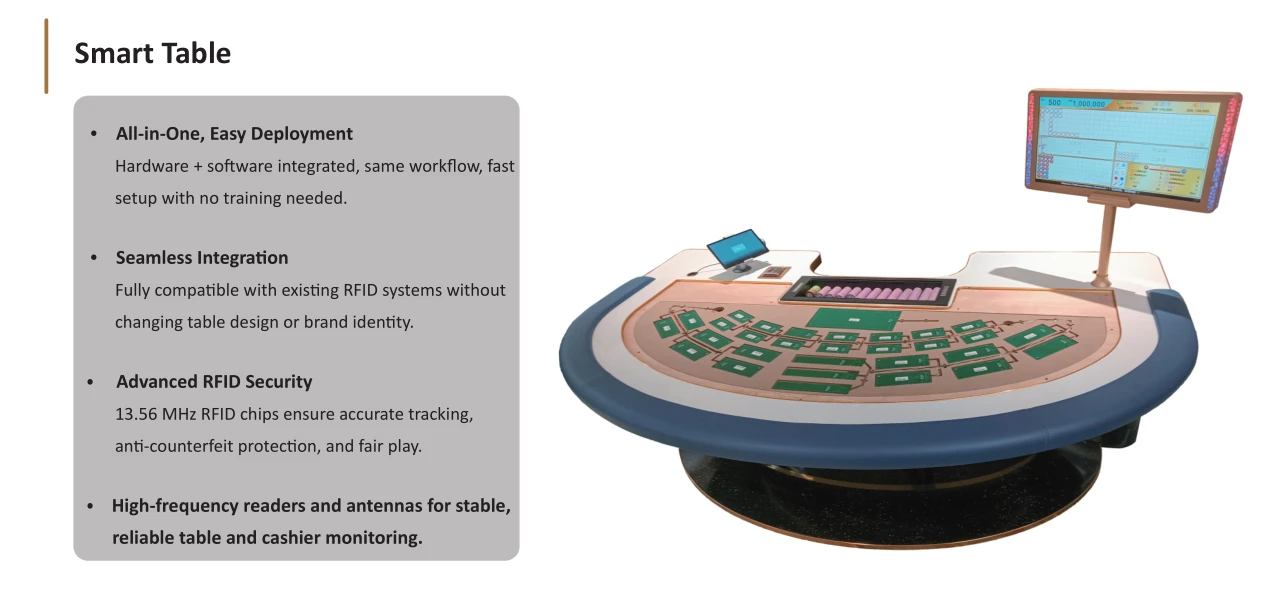
RFID casino chips solve this by embedding a micro-transponder inside each chip that broadcasts a unique encrypted ID to antenna arrays built into the gaming table surface. The table reads every chip in every betting spot, every second — no manual scan required.

How RFID Chip Verification Works on the Gaming Floor
The Three-Layer Authentication Stack
RFID chip verification operates on three authentication layers working simultaneously:
- RFID Tag Authentication — Each chip’s embedded tag carries a factory-encoded serial number, a casino-assigned denomination code, and a cryptographic signature. Antenna readers beneath the felt surface interrogate these tags at 13.56 MHz (HF) or 860–960 MHz (UHF), depending on system design.
- Database Cross-Referencing — Every scanned chip ID is validated against the cage management database in real time. If a serial number is unregistered, flagged as decommissioned, or assigned to a different denomination, the system triggers an alert within milliseconds.
- Positional Integrity — Antenna arrays map chip positions to specific betting spots. This means the system not only knows which chips are on the table but where they sit — detecting denomination swaps, chip capping, and past-posting attempts.
Read Speed and Accuracy Benchmarks
Current-generation RFID baccarat tables achieve a read accuracy rate of 99.7% per scan cycle with cycle times under 1.2 seconds. A full table of 120+ chips across all betting positions can be inventoried and validated before the dealer completes the hand.
This speed matters because baccarat — the highest-revenue game in Macau — processes 60–80 hands per hour. Verification must keep pace without adding latency to game flow.
Five Verification Scenarios RFID Catches That Manual Checks Miss
1. Counterfeit Chip Infiltration
A well-made counterfeit chip can pass visual and tactile inspection. It cannot replicate the encrypted RFID signature. When the system encounters a chip with no valid tag response — or a tag that returns an unrecognized code — it flags the chip and its position instantly.
Macau’s Gaming Inspection and Coordination Bureau (DICJ) now requires RFID verification on all gaming tables handling denominations above HK$10,000, making this capability a compliance necessity, not just a security enhancement.
2. Denomination Swapping
A player places a $5 chip on a $5,000 spot while the dealer is distracted. Without RFID, this goes unnoticed until the shift count — by which time the player is long gone. RFID tables lock chip denomination to betting position, flagging any mismatch immediately.
3. Chip Capping and Pinching
Capping (adding chips to a winning bet after the outcome) and pinching (removing chips from a losing bet) are among the oldest table game scams. RFID positional tracking detects any chip count change on a settled bet position and alerts the pit manager.
4. Decommissioned Chip Circulation
When a casino retires a chip series — common after large-scale heists or routine inventory cycles — the RFID database marks those serial numbers as invalid. Any decommissioned chip that reappears on the floor is identified on first scan, regardless of its physical condition.
5. Internal Shrinkage
Employee chip theft accounts for a significant share of unexplained inventory losses. RFID verification at cage checkpoints and table entry/exit points creates an audit trail that makes internal diversion traceable to the individual and the timestamp.
Implementation Blueprint: From Pilot to Full-Floor Deployment
Phase 1 — High-Limit Baccarat Pits (Weeks 1–4)
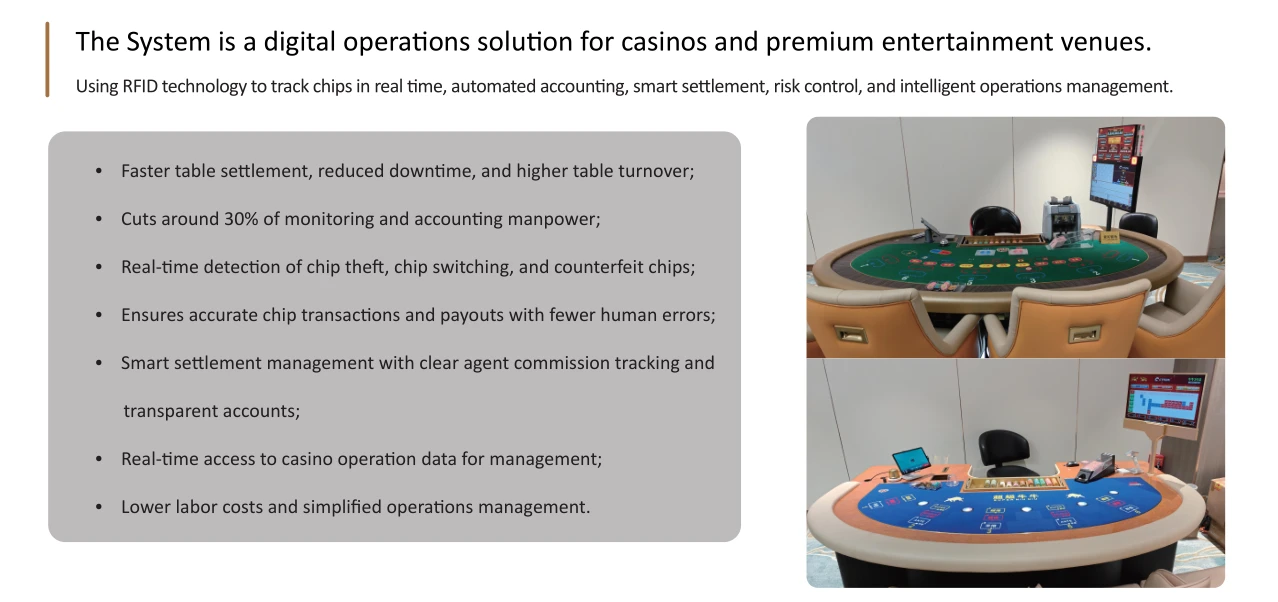
Start with your highest-denomination tables. These produce the largest single-hand exposure and deliver the fastest ROI. Equip 4–6 baccarat tables with RFID reader arrays and integrate with your existing cage management system.
Key deliverables:
- Antenna grid installation and calibration
- Chip database migration (tagging existing inventory or transitioning to new RFID-embedded chips)
- Pit manager dashboard deployment with real-time alerts
Phase 2 — Mid-Tier Tables and Cage Integration (Weeks 5–8)
Extend RFID verification to mid-denomination tables and cage intake/outtake points. This creates end-to-end chip lifecycle tracking — from cage to table and back.
Phase 3 — Full Floor and Analytics (Weeks 9–12)
Cover all table game positions. Activate analytics modules: chip velocity tracking, denomination flow heatmaps, and automated variance reporting. This phase transforms RFID from a security tool into an operational intelligence platform.
Cost Structure and ROI Timeline
| Component | Per-Unit Cost | Qty (50-Table Floor) |
|---|---|---|
| RFID Baccarat Table (reader-equipped) | $5,000 | 50 |
| Cage RFID Reader Board | $3,000 | 6 |
| SiM Cage Management System | $500/yr | 1 license |
| RFID-Embedded Chip Set (per table) | $800–$1,200 | 50 |
Total investment for a 50-table deployment: approximately $290,000–$310,000. Against annual counterfeit and shrinkage losses of $2–4 million for a mid-scale Macau property, the payback period is 9–18 months.

Integration With Existing Casino Infrastructure
One of the most common concerns operators raise before adopting RFID verification is compatibility with their current systems. The reality: modern RFID platforms are designed for modular integration, not rip-and-replace overhauls.
Cage Management Systems
RFID reader boards at cage windows connect to your existing cage management software via standard REST APIs. Whether you run a proprietary system or a vendor solution like the SiM Cage Management System, the integration typically requires a single middleware layer that translates RFID scan data into your system’s native format.
Pit Management Dashboards
Verification alerts feed directly into pit manager terminals. Most RFID table vendors offer dashboard software that runs on standard tablets or desktops — no proprietary hardware required. Alerts can also be pushed to smartwatches for pit bosses who patrol the floor on foot.
Surveillance and Audit Systems
RFID event logs integrate with casino surveillance (eye-in-the-sky) timestamp records. When a verification alert triggers, the system can automatically flag the corresponding surveillance footage for review, reducing investigation time from hours to minutes.
Compliance and Regulatory Considerations
DICJ’s updated guidelines mandate that all Macau concessionaires implement chip tracking technology capable of real-time verification by 2027. Operators who delay RFID adoption face two risks:
- Regulatory non-compliance — Potential fines, license conditions, or operational restrictions during the concession renewal process.
- Competitive disadvantage — Operators with verified chip systems can offer higher table limits with confidence, attracting premium players who demand fast, frictionless high-roller play.
The Custom RFID Baccarat Table solution is designed to meet DICJ compliance standards out of the box, with pre-calibrated antenna arrays and DICJ-compatible reporting modules.
Frequently Asked Questions
Can RFID verification slow down game speed?
No. Modern RFID systems scan and validate all chips on a table in under 1.2 seconds — faster than a dealer can settle a hand. The verification runs in parallel with normal game flow, adding zero perceptible latency.
Do RFID chips wear out or lose their signal?
RFID tags embedded in casino chips are passive (no battery) and rated for 10+ years of continuous use. The tag’s antenna is protected within the chip’s composite structure, making it resistant to physical wear, cleaning chemicals, and temperature variations common on gaming floors.
What happens when the system detects a suspicious chip?
The pit manager dashboard displays an immediate alert with the chip’s position, serial number, and the nature of the anomaly (unregistered, decommissioned, denomination mismatch). The dealer is not interrupted during active play — the pit manager investigates between hands or after the current game concludes.
Is RFID verification required by Macau gaming regulations?
DICJ’s 2027 compliance deadline requires real-time chip tracking on all high-denomination tables. While not every table needs full RFID coverage today, the regulatory direction is clear: full-floor RFID verification is becoming a condition of concession renewal.
Can existing non-RFID chips be retrofitted?
Retrofitting existing chips with RFID inserts is technically possible but not cost-effective for most operators. The recommended approach is to transition to new RFID-embedded chip sets during scheduled inventory rotations, phasing in RFID chips denomination by denomination.