Casino poker chips are made from clay composite, ceramic, acrylic or plastic with a metal slug, and the material decides the weight, feel and print method. Clay composite and ceramic chips dominate casino floors, while acrylic suits transparent, holographic and commemorative designs.
Authentic casino poker chips are primarily compression-molded clay composites, a sophisticated blend of clay, chalk, sand, calcium carbonate, and proprietary resins. Far from being 100% pure clay (a myth still circulating in many poker circles), modern professional tokens combine these materials under extreme heat and pressure to achieve the legendary clink, premium stackability, and durable feel that high-stakes players demand. Most genuine casino chips weigh between 10-14 grams and incorporate advanced anti-counterfeiting features.
Here’s a perfect stack of classic clay composite casino poker chips – notice the crisp edge spots and rich inlay colors that define professional play:

The Historical Evolution of Poker Chip Materials
Poker chips have come a long way since the 1800s:
- Early days (1800s–1880s): Handmade from ivory, bone, wood, or simple clay-shellac mixtures.
- Late 19th to mid-20th century: True clay composition chips became standard, with a fixed color code in which each denomination carried its own color across the floor.
- 1950s–1970s transition: Pure clay proved too brittle for heavy casino use → manufacturers introduced durable composites.
- 1980s onward: Ceramic and advanced composite formulations took over, especially with brands like Paulson, Bud Jones, and Matsui dominating the market.
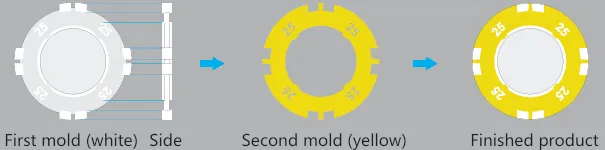
This cross-section-style view illustrates the layered construction typical of modern compression-molded chips:
Modern Materials Used in Casino Poker Chips
Today’s professional gaming tokens fall into three main categories:
Clay Composites (Industry Gold Standard)
- Composition: ~30-50% clay + fillers (chalk, sand, calcium carbonate) + resins/binders.
- Weight: Usually 11.5–14 grams.
- Hallmarks: Authentic metallic clink, excellent shuffle feel, superior stack stability.
- Used by: Most major casinos worldwide (Bellagio, Aria, WSOP events, etc.).
Ceramic / Injection-Molded Chips
- Composition: High-grade resin or porcelain-like formulas.
- Weight: 8–12 grams.
- Advantages: Full-surface printing, extreme durability, shatter resistance.
- Trade-off: Slightly less tactile “snap” compared to clay.
Acrylic Chips (Premium Transparent / Custom Option)
- Composition: High-clarity acrylic (PMMA) – injection-molded solid piece, often crystal-clear or tinted.
- Weight: Typically 6–10 grams (lighter than clay).
- Hallmarks: Luxurious glossy finish, excellent UV printing for vibrant designs, high scratch resistance, easy to clean.
- Advantages: Stunning visual appeal (especially transparent versions), durable against wear, popular for casino high-stakes gambling.
Here are stunning examples of high-transparent acrylic crystal poker chips – perfect for custom or luxury casino setups:
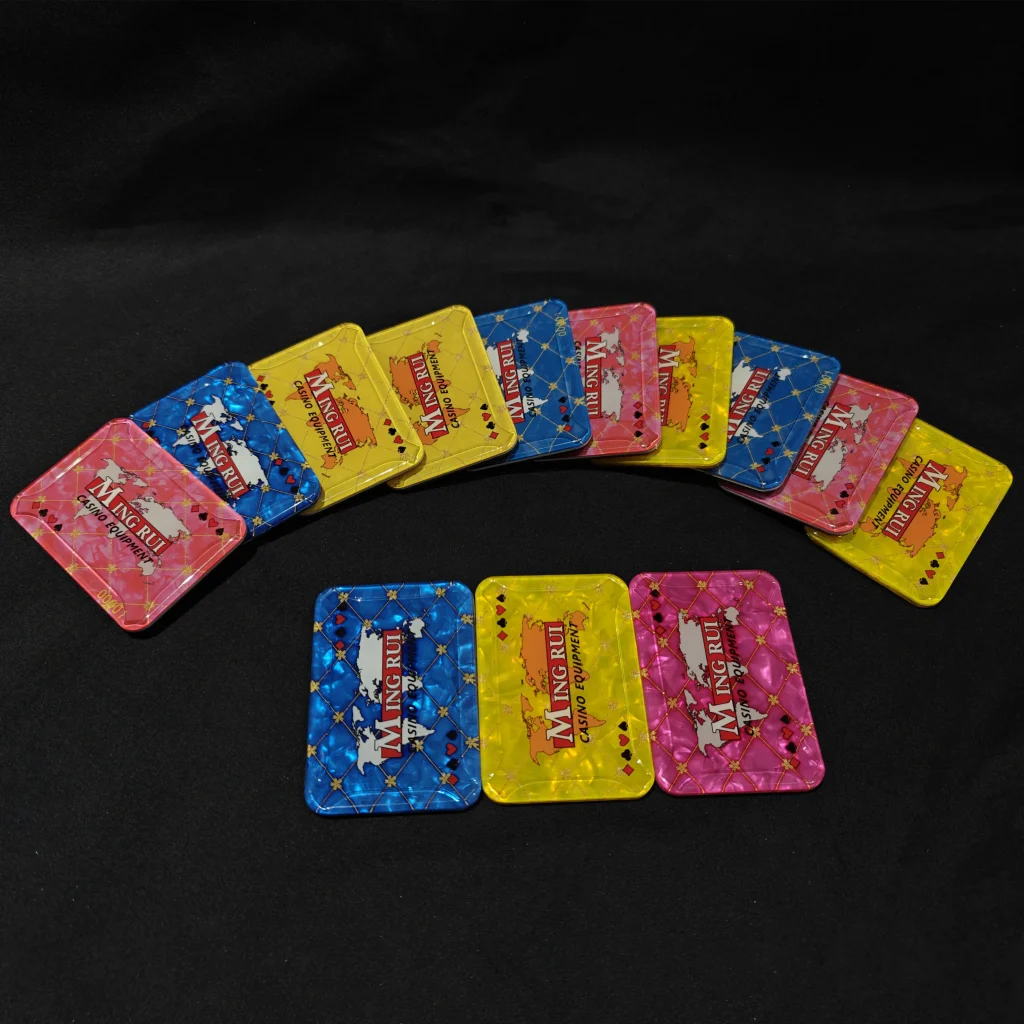
And a premium acrylic set with vibrant custom printing:
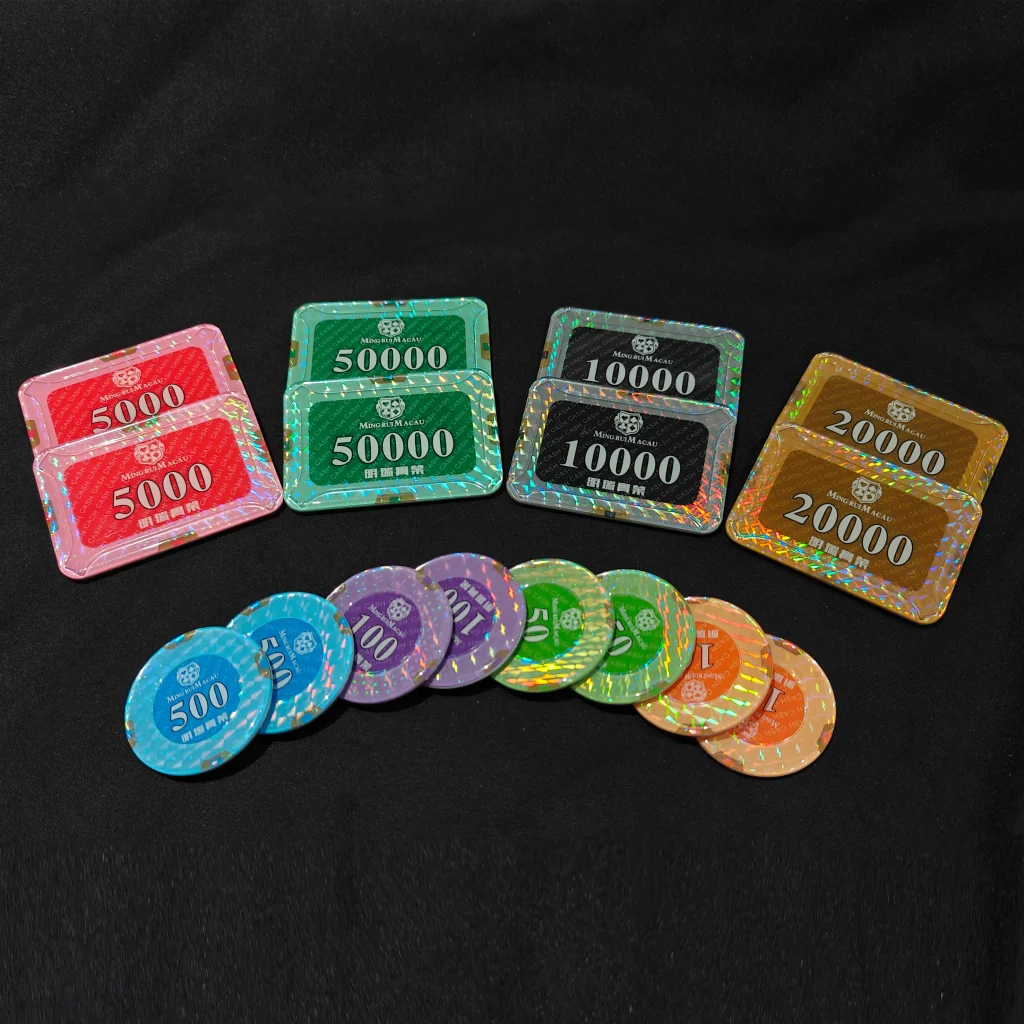
Plastic / ABS with Metal Slug
- Composition: Polymer body + embedded metal core.
- Weight: 11–13 grams.
- Best for: Budget home games.
How Are Casino Poker Chips Manufactured? (Step-by-Step)
The production of premium compression-molded clay chips is a tightly controlled, high-precision process (acrylic chips use simpler injection molding):
- Material Blending — Precise ratios of clay, fillers, pigments, and resins are mixed.
- Pre-forming — Material is pressed into rough blank shapes.
- Compression Molding — Blanks go into hydraulic presses at ~10,000 PSI and 300°F+ for several.
- Edge Spotting → Colored edge inserts are inserted.
- Finishing → UV protective coatings, laser engraving, holograms, and RFID options.
Take a look behind the scenes at actual compression molding equipment used by top manufacturers:

Comparing Poker Chip Types: Which Material Is Best for Your Game?
| Material Type | Typical Weight | Authentic Clink | Durability | Graphics Quality | Stack Feel | Best Use Case | Approx. Cost per Chip |
|---|---|---|---|---|---|---|---|
| Clay Composite | 11.5–14g | Excellent | Very Good | Very Good | Superior | Professional / Tournament play | Premium tier |
| Ceramic | 8–12g | Good | Excellent | Outstanding | Good | Custom home sets, high-volume casinos | Mid tier |
| Acrylic | 6–10g | Fair–Good | Good–Very Good | Excellent (UV pop) | Average–Good | Luxury home games, dealer buttons, commemoratives | Mid tier |
| Plastic / ABS + Slug | 11–13g | Fair | Good | Good | Average | Casual home games, budget setups | Entry tier |
Common Questions About Casino Poker Chip Materials (FAQ)
No. Since the 1960s–70s, virtually all professional chips use clay composites for vastly improved durability.
Clay composites offer superior sound and feel; ceramic provides better graphics and longevity with a slightly different tactile experience.
Clay composites deliver superior sound and weight feel for authentic casino action; acrylic offers glamorous transparency, vibrant custom graphics, and easier maintenance.
High-clarity acrylic (PMMA) chips allow stunning transparent effects, deep UV-printed graphics, and vibrant edge spotting that pop under modern casino. Their glossy, scratch-resistant finish and ease of cleaning, along with acrylic’s visual luxury and customization potential, have driven huge demand in the casino in 2026.
Ready to upgrade your chip inventory with authentic, secure, and visually stunning gaming tokens? Contact our team today for casino-grade samples, pricing on bulk runs (clay composite, ceramic, acrylic + RFID options), and compliance documentation. Let’s build your next generation of table-ready checks.
Which casino chip material should a buyer choose?
Material choice follows the application. Clay composite chips give the traditional casino weight and edge feel that floor games and tournaments expect; ceramic chips carry a full-surface print on a dense body and are common in premium poker rooms; acrylic chips allow transparent, holographic and shaped designs for high-limit or commemorative sets; plastic chips with a metal slug serve casual and promotional use.
Where the floor needs electronic identification, the same chip can be produced in an RFID-enabled version. RFID chips are supplied for 13.56 MHz (ISO 15693) reader environments and pair with the casino chip RFID reader range and the SiM Cage management system. Compatibility is confirmed against the reader model, reading zones and software before production, because the chip only works as part of a complete workflow.
What should be confirmed before a chip order goes into production?
- Material and weight class matched to the game and the room standard.
- Denomination ladder with a color and edge-spot scheme that stays readable across every step.
- Artwork and security including logo inlay, printed detail and any holographic element.
- RFID configuration where chips must be electronically identified and tracked.
How do you source custom casino chips?
Macaumr produces casino chips in clay composite, ceramic and acrylic builds as well as RFID-enabled versions, and has manufactured casino equipment in Panyu, Guangzhou since 2013 (About Macaumr). The full range is listed in the casino chips collection, including clay poker chips and ceramic poker chips.
There is no fixed minimum order quantity: the minimum is confirmed per project because it depends on the material, artwork, denomination split and packaging. Production typically takes about one to two weeks after the specification and artwork are approved, and reference samples are available for a non-refundable sample fee.
Send the material requirement and denomination range to the Macaumr team, or reach them on WhatsApp at +853 63403801, on Telegram at https://t.me/lym52 or by email at [email protected]. The contact page lists the same channels.
Frequently asked questions
What are casino poker chips made of?
Casino poker chips are made from clay composite, ceramic, acrylic or plastic compounds, and many designs include a metal slug for weight. The material determines the feel, the weight class and how artwork is applied, from full-surface ceramic printing to inlaid clay composite designs and transparent acrylic finishes.
Which poker chip material is used in real casinos?
Clay composite and ceramic chips are the two materials used on most casino floors. Clay composite chips provide the traditional weight and edge feel for high-volume games, while ceramic chips offer a dense body with full-surface printing for poker rooms and premium tables. Acrylic chips appear in VIP and commemorative sets.
Are clay chips and clay composite chips the same thing?
No. True clay chips are rare and brittle, so modern casino chips described as clay are clay composite: a molded compound that behaves like clay in the hand but resists chipping. The composite construction is what allows edge spots, inlays and repeated handling on a casino floor.
How much do casino chips weigh?
Weight depends on the material and the internal slug. Clay composite and ceramic casino chips sit in the traditional casino weight range, while acrylic and plastic chips are lighter unless a metal slug is added. Weight class is specified with the material, because it affects how the chips stack and feel during play.
Can casino chips be made with RFID inside?
Yes. RFID chips carry an embedded tag and are produced in clay composite, ceramic and acrylic builds. They require a compatible reader and software, so the chip specification is confirmed against the reader model, reading zones and the casino management system before production begins.
How do I order custom casino chips?
Send the material, denomination ladder, artwork and quantity to the Macaumr team. There is no fixed minimum order quantity; the minimum is confirmed per project. Production typically takes about one to two weeks after the specification and artwork are approved, and reference samples are available for a non-refundable sample fee.