Casino playing cards are the most handled, most scrutinized, and most frequently replaced items on any gaming floor. Yet many operators treat card procurement as a routine purchasing decision rather than a critical component of game integrity and player trust. According to a 2023 study by the University of Nevada, Las Vegas (UNLV) Center for Gaming Research, the average active baccarat table in Macau goes through approximately 12–15 decks of playing cards per day, making card durability and security directly tied to operational bottom lines. For casino operators and procurement managers, understanding the material science, customization standards, and anti-counterfeiting features of casino playing cards is essential for maintaining game integrity and controlling costs.
Whether you run a high-limit baccarat pit or a mass-market blackjack floor, the cards you deploy affect dealing speed, player confidence, and surveillance effectiveness. This guide examines the key factors that separate professional-grade casino cards from consumer-grade alternatives, with a focus on material quality, customization for security, and operational best practices. For a deeper dive into card materials, see our guide to casino playing card material science and customization standards.
Operators looking to source cards in bulk can explore our casino playing cards collection or specifically our paper playing cards collection for validated options.
Why Casino Playing Cards Matter for Game Integrity
The connection between card quality and game integrity is not theoretical. The UNLV Center for Gaming Research reported in 2023 that card-related incidents—including marked cards, torn cards causing dealing errors, and cards compromised through wear—account for approximately 18% of table game disputes logged by surveillance teams in major Las Vegas properties. This statistic underscores a reality that experienced pit managers know well: inferior cards create vulnerabilities.
Casino playing cards must meet three fundamental integrity requirements. First, they must resist marking through normal handling—meaning no fingernail impressions, bend marks, or friction wear should be visible after hours of use. Second, they must maintain consistent opacity so that back designs cannot be read through light sources, including the overhead cameras that surveillance teams use. Third, they must retain their structural properties—stiffness, flexibility, and dimensional stability—through hundreds of deals across varying humidity and temperature conditions.
When cards fail any of these tests, the consequences extend beyond individual hands. Players who notice worn or marked cards may question the fairness of the game, leading to disputes that require pit supervisor intervention and, in serious cases, gaming commission review. For operators in regulated markets like Macau, where the Gaming Inspection and Coordination Bureau (DICJ) mandates specific card standards, using substandard cards can result in compliance violations.
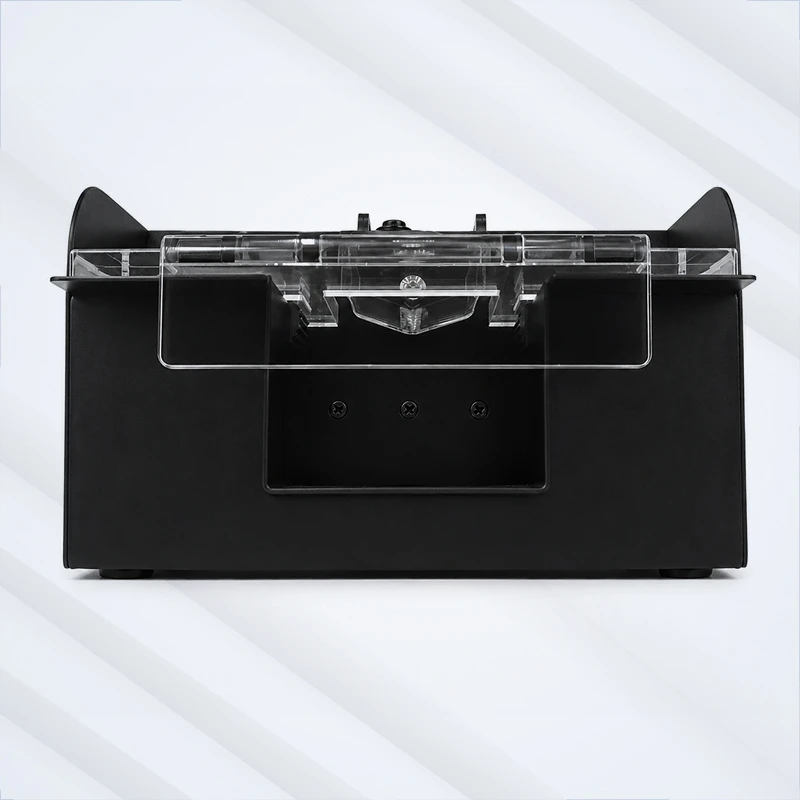
Pairing quality cards with reliable shuffling equipment further protects game integrity. The CS07 2 Deck Casino Card Shuffler eliminates manual shuffling inconsistencies that can inadvertently create predictable card sequences, ensuring that each deal begins from a genuinely randomized state.
Card Material Science: Black Core Paper vs. Blue Core Paper vs. Plastic
The material composition of a casino playing card determines its opacity, durability, feel, and security properties. Three primary material categories dominate the casino supply market, each with distinct advantages and trade-offs.
German Black Core Paper
German black core paper is widely considered the gold standard for casino playing cards. The black opaque layer sandwiched between two white paper layers achieves near-total opacity, preventing any light transmission that could allow card backs to be read through strong light sources. This is the material preferred by major casino brands for high-limit baccarat and blackjack tables. According to manufacturing specifications from leading suppliers, German black core paper typically uses 310gsm weight with a proprietary coating that enhances both durability and handling feel. For a comprehensive sourcing analysis, see our article on German black core paper casino playing cards.
Operators can source this premium material directly through products like Korea Black Core Paper Casino Poker Cards, which offer the same opacity benefits with customization options for brand-specific back designs.
China Black Core Paper
China black core paper offers a cost-effective alternative to German-made stock while maintaining the critical black opaque layer. At 310gsm, quality Chinese black core paper achieves opacity levels suitable for most casino applications, though the coating quality and fiber consistency may not match German standards. For mid-tier operations or venues with high card replacement rates, China Black Core Paper Casino Cards provide a practical balance between security and cost efficiency.
Blue Core Paper and Plastic
Blue core paper uses a blue opaque layer that provides moderate opacity—sufficient for lower-stakes games but not ideal for high-limit pits where surveillance cameras and determined players might exploit partial transparency. Plastic cards (typically PVC or cellulose acetate) offer superior durability and water resistance, making them suitable for outdoor gaming areas or environments with high humidity, though they lack the traditional paper feel that many baccarat players prefer.
Custom Casino Playing Cards: Security Features and Brand Protection
Custom casino playing cards serve dual purposes: they reinforce brand identity and they function as security instruments. The customization process involves several security-conscious design decisions that go beyond aesthetic preferences.
Back design complexity is the first line of defense against counterfeiting. Intricate, asymmetric patterns with proprietary color combinations are extremely difficult to replicate without access to the original printing plates and ink formulations. Leading card manufacturers use specialized printing techniques—including offset lithography with UV-cured inks—that produce visual characteristics detectable by trained surveillance staff but nearly impossible to reproduce on commercial printers.
Customization also extends to invisible security features. Many casino-grade cards now incorporate UV-reactive elements embedded in the back design or within the card structure itself. These elements are invisible under normal lighting but glow distinctly under UV lamps, allowing surveillance teams to authenticate card decks quickly during routine checks or suspected fraud incidents. The Gaming Standards Association (GSA) has documented these authentication protocols in their technical standards for table game equipment, providing a framework that operators can reference when specifying card security requirements to manufacturers.
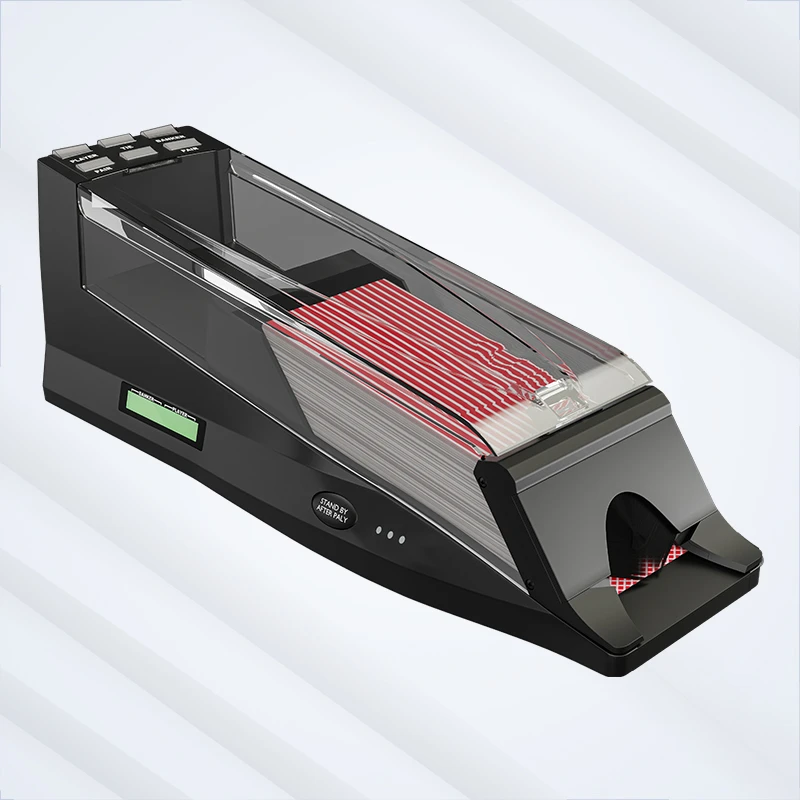
For baccarat operations specifically, custom cards integrate with intelligent dealing shoes that read card values electronically. The transparency of the dealing shoe shown above allows surveillance to visually confirm that the physical cards match the electronic readings—a dual-layer verification system that strengthens game integrity.
Card Durability and Operational Cost Analysis
Durability is not just a quality metric; it is a direct cost driver. A casino operating 20 active baccarat tables with each table using 8 decks per shoe and changing decks every 4 hours requires approximately 160 decks per day. At this volume, the difference between cards that last 8 hours versus 12 hours translates to thousands of dollars in annual savings per table.
Key durability factors include:
- Coating quality: UV-cured coatings resist friction wear significantly better than aqueous coatings, extending card life by 30–50% based on internal testing by major card manufacturers.
- Edge treatment: Cards with precision-cut edges resist layer separation, which is the primary failure mode for paper cards under repeated shuffling and dealing stress.
- Environmental resistance: Cards treated with moisture-resistant coatings maintain stiffness and dimensional stability in the humid environments common in Macau and Southeast Asian casino markets.
- Shuffling method: Automatic shuffling machines reduce mechanical stress on cards compared to manual shuffling, extending usable life by approximately 25% according to floor operations data from multiple Macau properties.
Operators should calculate total cost of ownership rather than per-deck price. A deck costing 40% more but lasting 60% longer delivers net savings, particularly when labor costs for deck changes and surveillance review of disputed hands are factored in.
Card Maintenance and Replacement Protocols
Even the highest-quality casino playing cards require structured maintenance and replacement protocols. The International Association of Gaming Regulators (IAGR) recommends that casinos establish documented card rotation schedules based on game type, table volume, and card material specifications.
Best practices for card lifecycle management include:
- Rotation schedules: Baccarat decks should be replaced every 4–8 hours of active play, depending on table traffic and environmental conditions. Blackjack decks typically last longer due to fewer cards in play per round.
- Inspection checkpoints: Dealers and floor supervisors should visually inspect cards at each shoe change for signs of marking, edge wear, or coating degradation. Any card showing visible wear should trigger a full deck replacement.
- Secure disposal: Used cards must be rendered unreadable before disposal. Standard practice involves cutting or shredding cards in a secured area, with disposal documented in a log reviewed by surveillance.
- Inventory tracking: Each deck should be serialized and tracked from receipt through deployment to disposal. This chain-of-custody documentation is essential for gaming commission audits and fraud investigations.

Card maintenance protocols should be integrated with broader table security systems. When cards are deployed alongside RFID-enabled chips and smart table technology, the entire table ecosystem—cards, chips, and dealing equipment—works together to create a verifiable record of every action taken during play.
How Playing Cards Integrate with Modern Casino Table Systems
Modern casino tables are no longer standalone surfaces where cards and chips exist in isolation. Today’s gaming floors deploy integrated systems where playing cards are one component in a connected security and operations network. Electronic dealing shoes read card values in real time, feeding data to baccarat roadmap displays and pit management software. RFID table systems track chip movements against card outcomes, automatically flagging statistical anomalies that could indicate advantage play or collusion.
For this integration to function correctly, the playing cards themselves must meet precise dimensional and material specifications. Cards that are too thick may jam in electronic shoes; cards with inconsistent coating may cause optical sensors to misread values; cards that absorb humidity may warp enough to affect dealing shoe mechanics. These technical requirements make card procurement a decision that affects not just the table games department but the entire casino technology infrastructure.
Operators planning table system upgrades should ensure their card specifications are compatible with their dealing equipment and surveillance systems. Consulting with equipment manufacturers during the card specification process can prevent costly compatibility issues and ensure that the integrated system performs as designed.
Frequently Asked Questions
What makes casino playing cards different from regular playing cards?
Casino playing cards differ from regular playing cards in three critical ways: they use black or blue opaque core layers to prevent light transmission, they are manufactured to precise dimensional tolerances (typically 63mm x 88mm with ±0.1mm variation), and they incorporate security features such as UV-reactive inks and proprietary back designs. Regular playing cards lack these features, making them unsuitable for regulated casino environments where game integrity and surveillance verification are mandatory.
How often should casino playing cards be replaced?
Casino playing cards should be replaced every 4–8 hours of active table use, depending on game type and table volume. High-traffic baccarat tables in Macau typically replace decks every 4 hours, while lower-volume blackjack tables may extend deck life to 8 hours. The IAGR recommends that operators establish written replacement schedules based on manufacturer specifications and observed wear patterns, with mandatory immediate replacement for any deck showing visible marking or damage.
Can custom casino playing cards prevent cheating?
Custom casino playing cards significantly reduce cheating risk through proprietary back designs that are difficult to counterfeit, UV-reactive security elements that enable rapid authentication, and manufacturing tolerances that prevent edge-sorting exploits. While no single measure eliminates all cheating risk, custom cards combined with electronic dealing shoes, RFID chip tracking, and trained surveillance teams create a multi-layered defense that makes systematic card manipulation extremely difficult to execute without detection.
Conclusion
Casino playing cards represent a critical intersection of material science, security engineering, and operational economics. The choice between German black core, China black core, blue core, or plastic cards should be driven by specific operational requirements—table volume, regulatory environment, surveillance infrastructure, and budget constraints—rather than defaulting to the cheapest available option.
For operators committed to maintaining game integrity and player trust, investing in quality cards with appropriate security features delivers measurable returns through reduced disputes, lower replacement frequency, and enhanced surveillance effectiveness. When cards are specified as part of an integrated table system that includes quality shuffling equipment, RFID tracking, and trained personnel, they contribute to a comprehensive security posture that protects both revenue and reputation.
Procurement decisions for casino playing cards should involve input from table games management, surveillance, compliance, and equipment vendors to ensure that all operational and security requirements are met. By treating card procurement as the strategic decision it truly is, operators can avoid the costly consequences of compromised game integrity and build player confidence in every deal.