Casino playing cards are the most handled, most consumed, and most scrutinized piece of equipment on any gaming floor. Yet many casino operators treat card procurement as an afterthought, defaulting to whatever supplier offers the lowest per-deck price without examining the material science, customization options, and quality standards that directly impact game integrity, dealer efficiency, and player trust.
This guide breaks down the technical specifications that separate professional-grade casino playing cards from retail-grade alternatives. We examine the core paper formulations used by leading manufacturers, the customization features that enhance both security and brand identity, and the total cost of ownership metrics that should drive procurement decisions for high-volume table game operations.
Whether you are sourcing cards for a 200-table mega-resort or a boutique VIP club, understanding the material hierarchy — from 280g China blue core to 310g German black core — will help you match card stock to game type, table stakes, and replacement cycles. For a broader overview of material categories and specifications, see our guide to casino playing cards.

Casino Playing Card Materials: Core Paper Technology Explained
The internal core of a casino playing card is the single most important factor determining opacity, flexibility, durability, and shuffle feel. Casino-grade cards use a sandwich construction: two outer printed layers bonded to an opaque inner core that prevents light transmission and eliminates the possibility of card marking through backlighting.
There are three primary core paper categories used in professional casino cards:
Blue Core Paper (280g)
China-manufactured blue core paper at 280g represents the entry point for casino-grade cards. The blue core provides adequate opacity for standard table game use, blocking approximately 92% of transmitted light. At 280 grams per square meter, these cards offer a balance of flexibility and rigidity that suits mid-volume gaming floors where decks are replaced every 4 to 6 hours. The Customizable 280g China Blue Core Paper Poker Cards for Casino represent this category, offering operators a cost-effective option for mass-market table games.
Black Core Paper (310g)
Black core paper represents the industry standard for premium casino cards. The black inner layer blocks over 99% of transmitted light, making it virtually impossible to read card faces through backlighting or side-lighting attacks. Two regional variants dominate the market:
China black core (310g): Domestic manufacturing has improved significantly, with Chinese mills now producing black core paper that meets most international casino specifications. The Customizable Deck of Cards Casino Made of 310g China Black Core Paper offers operators a domestic alternative with strong opacity at competitive pricing. China black core cards typically serve mid-to-high-volume tables with 6 to 8 hour replacement cycles.
Korean black core: Korean-manufactured black core paper is recognized for its superior fiber density and consistent caliper across production runs. Korean core cards tend to maintain their snap and flexibility longer under high-humidity conditions, making them suitable for tropical markets. The Customizable Casino Poker Cards Made of Import Korea Black Core Paper cater to operators who prioritize humidity resistance and longer deck life.
German Black Core Paper (310g)
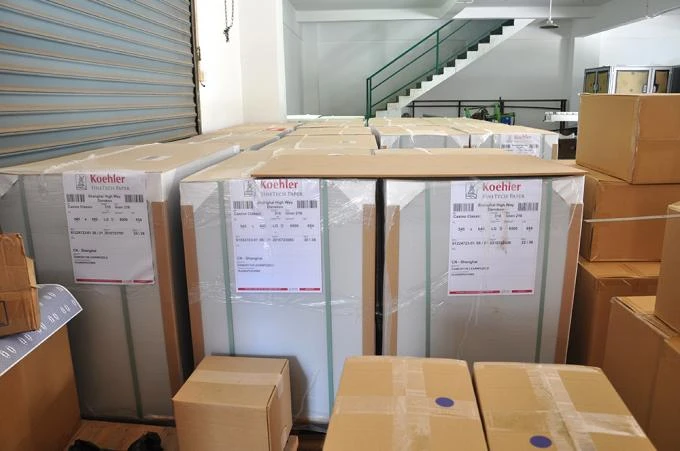
German black core paper, produced by specialty mills with decades of casino supply experience, is widely considered the gold standard for casino playing cards. The manufacturing process uses longer cellulose fibers and higher compression pressures, resulting in a card stock that maintains its structural integrity through 30% more shuffles than standard black core alternatives. German core cards are the preferred choice for high-stakes baccarat rooms where deck replacement cycles of 1 to 2 hours are standard. The Customizable Imported 310g German Black Core Paper Playing Cards for Casino serve this premium segment.
Operators should match core paper selection to game type and stakes. Low-margin, high-volume blackjack tables can operate effectively with 280g blue core cards, while VIP baccarat rooms require the superior opacity and durability of 310g German black core stock. Explore the full range of options in our paper playing cards collection.
Custom Casino Playing Cards: Branding, Security, and Compliance Features
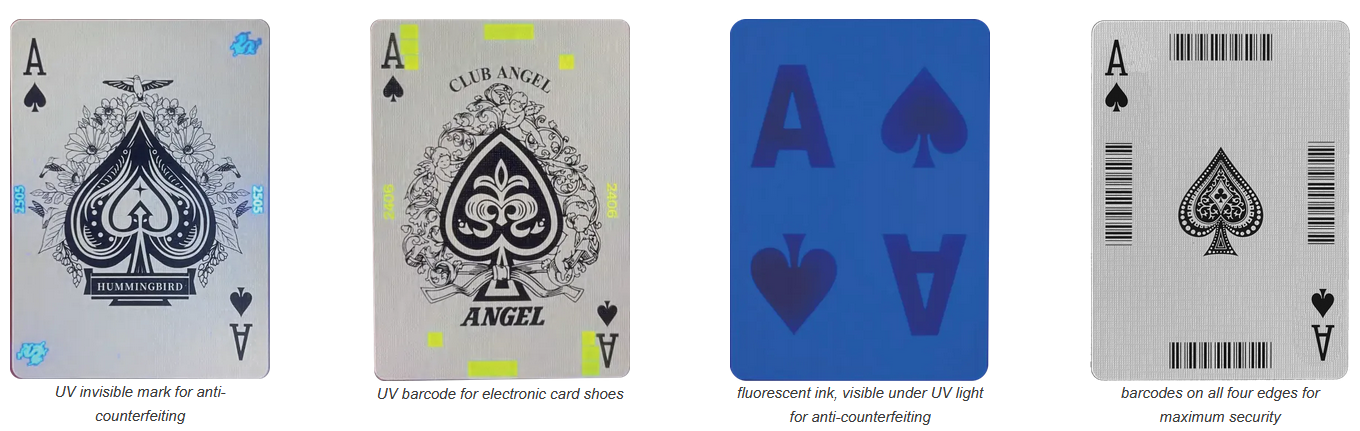
Customization is not merely a branding exercise. For casino operators, custom playing cards serve as a critical layer of game security, regulatory compliance, and operational identification. Every customization element — from back design to edge coding — should be evaluated against anti-counterfeiting requirements and jurisdictional gaming commission standards.
Back Design and Color Customization
Custom back designs serve dual purposes: brand reinforcement and security differentiation. Casinos should commission unique back patterns that are difficult to replicate without the original printing plates. Pattern complexity directly impacts counterfeiting difficulty — geometric patterns with 8 or more color stations require specialized printing equipment that most counterfeiters cannot access. Color selection should incorporate at least one Pantone-matched specialty color that cannot be reproduced through standard CMYK process printing.
Edge Coding and Serialization
Many gaming jurisdictions require edge coding — microscopic markings applied to the edge of each card that identify the deck serial number and manufacturing batch. This enables surveillance teams to trace individual decks back to their procurement date and supplier, creating an auditable chain of custody. Edge coding is particularly important for high-limit rooms where deck manipulation is a primary fraud vector. For a deeper examination of card security technologies, see our article on casino playing card security.
Custom Faces, Indices, and Pip Configurations
Beyond backs, casinos can customize face cards with modified indices, proprietary suit symbols, or house-specific joker designs. VIP rooms often commission oversized indices for improved camera visibility, while poker rooms may request 4-color deck configurations to assist colorblind players. Custom face printing also serves as a security feature: a casino-specific face design cannot be substituted into an active game without immediate detection by dealers and surveillance.
Packaging and Tamper-Evident Seals
Deck packaging is the first line of defense against pre-deck tampering. Professional casino cards should be packaged in tamper-evident wrappers with serialized tear strips. Each wrapper should display a unique QR code or barcode that links to the manufacturing batch, enabling instant verification at the cage. Some operators are now incorporating RFID tags into deck packaging, allowing cage staff to scan and log deck issuance without manual data entry.

Casino Playing Card Lifespan: Total Cost of Ownership Analysis
Per-deck price is a misleading procurement metric. The true cost of casino playing cards is measured in cost-per-hour-of-play, which accounts for deck lifespan, replacement labor, and the operational impact of premature card degradation. A deck that costs 40% less but lasts 50% fewer hours is more expensive over a fiscal quarter.
According to a 2024 study by the University of Nevada, Las Vegas Center for Gaming Research, the average Las Vegas Strip casino replaces playing cards every 1 to 2 hours for baccarat, 2 to 4 hours for blackjack, and 4 to 8 hours for poker cash games. This translates to annual deck consumption of approximately 25,000 to 40,000 decks for a mid-sized casino with 80 table games.
Key factors affecting card lifespan include:
- Game pace: Fast-paced games like blackjack generate more shuffles per hour, accelerating edge wear and surface scuffing.
- Dealer technique: Proper shuffling technique reduces bending stress. Casinos with structured dealer training programs report 15 to 20% longer deck life.
- Environmental conditions: Humidity above 65% degrades paper fiber integrity. Coastal and tropical venues should prioritize humidity-resistant core stocks.
- Table felt condition: Worn or abrasive felt surfaces accelerate card face wear. Replacing felt on schedule extends card life by 10 to 15%.
- Shuffler compatibility: Mechanical card shufflers apply consistent pressure that can either extend or reduce card life depending on calibration. Using matched shuffler-card combinations from our card shuffler collection ensures optimal compatibility.
Procurement managers should conduct quarterly deck-life audits, tracking average hours of play per deck by game type and core material. This data enables precision forecasting of annual card budgets and identifies opportunities to adjust core paper selection or replacement cycles for cost optimization.
Plastic vs Paper Casino Playing Cards: Application-Specific Selection
The debate between plastic and paper playing cards is not about superiority — it is about application fit. Each material excels in specific gaming environments, and the most efficient operators use both, matched to game requirements.
Paper Cards: The Casino Standard
Paper cards remain the standard for live casino table games for three reasons: superior shuffle feel, predictable degradation patterns, and lower per-unit cost. Paper cards develop a characteristic “break-in” within the first 30 minutes of play that dealers prefer for handling speed. Equally important, paper cards show visible wear in predictable patterns — dealers and floor supervisors can identify a deck approaching replacement threshold by touch and visual inspection. This predictable degradation is a security feature: cards that degrade too slowly may have been treated with performance-enhancing coatings, signaling potential manipulation.
Plastic Cards: Durability for High-Traffic Environments
Plastic (PVC) playing cards offer 10 to 15 times the lifespan of paper cards under equivalent conditions. They are waterproof, washable, and resistant to bending and creasing. For poker rooms with extended session times, tournament formats, or outdoor gaming areas, plastic cards dramatically reduce replacement frequency and labor costs. The Custom Plastic Waterproof Playing Cards and Packaging Box for Casino Poker Game cater to operators who need maximum deck longevity.
However, plastic cards have distinct trade-offs. Their shuffle feel differs from paper, requiring dealer adjustment. They do not show wear in the same predictable patterns, making it harder to identify decks that should be retired. Some gaming jurisdictions restrict plastic cards to poker rooms and prohibit their use in baccarat or blackjack, where the tactile feedback of paper cards is considered integral to game supervision. Review options in our plastic playing cards collection.
Quality Control Standards: What Casino Operators Must Verify
Professional casino card procurement requires verification of specific quality control metrics that are not typically listed in supplier catalogs. Operators should request the following specifications from manufacturers before committing to volume orders:
Caliper Consistency
Card caliper (thickness) should not vary by more than ±0.02mm across a deck. Inconsistent caliper creates detectable thickness differences that advantage skilled card counters and mechanics. Professional manufacturers use laser micrometers to verify caliper across every sheet during production.
Opacity Rating
Casino-grade cards must achieve minimum opacity ratings: 95% for blue core, 99% for black core, and 99.5% for German black core. Operators should request opacity test certificates from manufacturers. Cards that fall below these thresholds are vulnerable to backlight marking attacks.
Surface Coating Durability
The protective coating on card faces and backs should withstand a minimum of 5,000 shuffle cycles before showing visible scuffing. Request abrasion test data using the Taber abrasion test (ASTM D3884) as a standardized comparison metric across suppliers.
Color Fastness
UV exposure from surveillance lighting and natural light can fade card inks over time. Request color fastness ratings of grade 4 or higher on the ISO 105-B02 grey scale. Cards that fade unevenly can create visible patterns that advantage observant players.
Cut Precision
Cards must be cut to consistent dimensions with ±0.5mm tolerance on length and width. Poorly cut cards produce visible edge misalignment when squared in a deck, which can compromise shuffle integrity and dealing mechanics. Modern casino card manufacturers use servo-driven guillotine cutters with optical registration to maintain these tolerances.
FAQ: Casino Playing Cards
How often should casino playing cards be replaced?
Casino playing cards should be replaced every 1 to 2 hours for high-stakes baccarat, 2 to 4 hours for blackjack, and 4 to 8 hours for poker cash games. The University of Nevada, Las Vegas Center for Gaming Research reports that the average Las Vegas Strip casino consumes 25,000 to 40,000 decks annually across an 80-table floor. Replacement frequency should be determined by game pace, stakes level, and visible wear indicators rather than a fixed schedule.
What is the difference between blue core and black core playing cards?
Blue core cards use a blue inner layer that blocks approximately 92% of transmitted light, making them suitable for mid-volume tables. Black core cards use an opaque black inner layer that blocks over 99% of light, preventing backlight marking attacks and meeting the security requirements of high-stakes gaming. German black core paper represents the premium tier, offering superior fiber density and 30% longer shuffle life compared to standard black core alternatives.
Can casino playing cards be recycled or repurposed?
Casino playing cards can be recycled through specialized paper recovery programs, but most gaming jurisdictions require used decks to be rendered unusable before disposal. Standard practice involves cutting or hole-punching each deck before recycling. Some casinos sell cancelled decks as souvenirs, generating modest ancillary revenue while ensuring the cards cannot re-enter active play. Plastic cards can be returned to manufacturers for PVC reprocessing programs where available.
Conclusion
Casino playing card procurement is a technical discipline that demands the same rigor applied to chip tracking, surveillance systems, and table game analytics. The material hierarchy from 280g blue core to 310g German black core provides operators with clear options for matching card stock to game type, stakes, and environmental conditions. Customization features — from edge coding to tamper-evident packaging — serve as both brand differentiation and critical security layers.
By shifting procurement evaluation from per-deck price to total cost of ownership, and by implementing quarterly deck-life audits, operators can reduce annual card expenditures by 15 to 25% while improving game integrity. The data-driven approach to card selection outlined in this guide ensures that every deck on your gaming floor is matched to its operational context — protecting revenue, enhancing dealer efficiency, and maintaining the player trust that sustains long-term table game profitability.