Casino surveillance systems have evolved far beyond overhead cameras and pit-boss intuition. Modern casino floors now deploy integrated security architectures that combine RFID-embedded chips, AI-powered video analytics, real-time chip tracking, and automated dealer interfaces to detect fraud the moment it occurs. For casino operators and procurement managers, understanding these layered technologies is essential to protecting table game revenue and maintaining regulatory compliance.
According to the American Gaming Association, U.S. commercial gaming revenue reached $66.5 billion in 2023, with table games accounting for a significant portion of that total. Yet industry estimates from the University of Nevada, Las Vegas Center for Gaming Research suggest that casinos lose between 0.5% and 2% of gross gaming revenue to internal theft, external cheating, and operational errors annually. For a mid-sized casino generating $50 million in table game revenue, that translates to $250,000–$1,000,000 in preventable losses each year. Multi-layer casino surveillance systems directly address this vulnerability.
This guide examines how modern casino surveillance systems integrate RFID tracking, AI video analytics, and automated alert workflows to create a real-time security net across the entire gaming floor—from the cage to every table game pit.

The Architecture of Modern Casino Surveillance Systems
Today’s casino surveillance systems are built on a multi-layer architecture that combines physical sensors, networked software platforms, and human oversight. Unlike legacy setups where cameras and pit bosses operated independently, modern systems funnel data from every source into a unified monitoring dashboard.
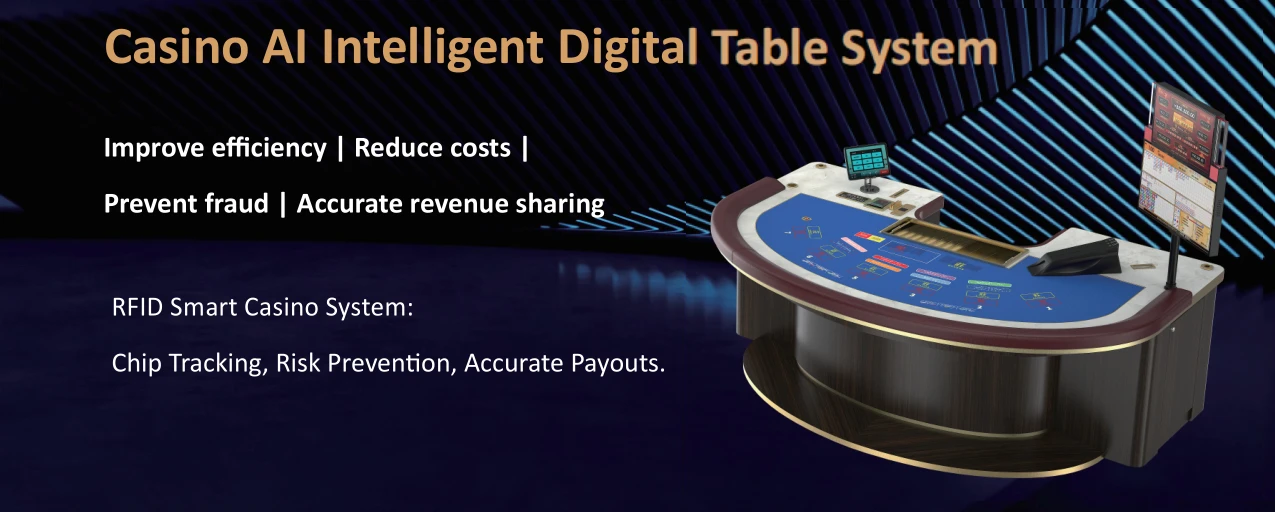
The foundational layer is hardware: RFID-embedded casino chips, antenna-equipped gaming tables, overhead PTZ cameras, and cage-side chip readers. These devices continuously stream data to a central surveillance server. The second layer is software: management platforms that aggregate chip movements, bet placements, and video feeds in real time. The third layer is analytics: AI algorithms that cross-reference chip positions with video footage to flag anomalies—such as a chip moving from a player’s stack to a dealer’s tray without a corresponding payout.
For operators investing in our RFID Gaming Table collection, this architecture provides the infrastructure backbone. Each table becomes a data node, feeding the surveillance network with granular transaction data that human observers simply cannot capture at scale. The result is a security ecosystem where every chip on the floor has a known location, a verified denomination, and a transaction history.
RFID Casino Security: Real-Time Chip Tracking and Anti-Counterfeiting
RFID casino security represents the single most impactful technology for preventing chip-based fraud. Each RFID-embedded chip contains a microchip with a unique serial number, denomination data, and cryptographic authentication. When placed on an RFID-enabled table or cage reader, the chip’s identity is verified in milliseconds—without any visible change to the player experience.

The cage is the first line of defense. When a player brings chips to the cage for redemption, RFID readers instantly verify each chip’s authenticity and denomination. If a counterfeit or unauthorized chip is detected, the system triggers an immediate alert—as shown in the monitoring interface above—allowing cage staff to detain the chip and notify surveillance before any payout occurs. This capability alone can save a casino hundreds of thousands of dollars annually in fraudulent redemptions.
Beyond the cage, RFID readers embedded in table game surfaces track every chip movement in real time. The system knows exactly how much each player has wagered, when chips change hands, and whether the dealer’s tray count matches the expected inventory. For operators seeking to implement this layer, the SiM Cage Management System provides an integrated software platform that connects cage operations, chip inventory, and surveillance alerts into a single workflow.
For casinos that need to source RFID-enabled chips at scale, our casino chips collection includes options with embedded RFID tags, holographic anti-counterfeiting labels, and UV fluorescent security patterns—providing multiple overlapping verification methods that make forgery virtually impossible.
AI Video Analytics: From Passive Recording to Active Detection
Traditional casino camera systems were reactive: surveillance teams reviewed footage after an incident occurred. AI-powered video analytics have transformed cameras into proactive detection tools. Modern systems use computer vision algorithms to analyze live video feeds from every table, automatically flagging suspicious behaviors such as past-posting bets, chip snatching, card switching, or dealer-player collusion patterns.
The integration of AI analytics with RFID data creates a powerful cross-verification system. If the RFID layer detects that a $500 chip has appeared on a table where no $500 buy-in was recorded, the AI video system can instantly pull the relevant camera angle and flag the moment the chip appeared. Surveillance operators receive a synchronized alert—video clip plus RFID anomaly—enabling them to make a determination within seconds rather than after hours of post-incident review.
This convergence of technologies is the defining feature of modern casino surveillance systems. Neither RFID alone nor video alone can provide the complete picture; together, they create a verifiable chain of evidence for every transaction on the floor. For a deeper exploration of how facial recognition specifically enhances this layer, see our article on AI and facial recognition in casino surveillance systems.
Dealer Interface Alerts: Stopping Fraud at the Table Level
One of the most effective fraud-prevention innovations in casino surveillance systems is the real-time dealer interface. These touchscreen displays, integrated with RFID table hardware, provide dealers with continuous feedback on chip positions, bet amounts, and game state—and they generate automated alerts when something is wrong.
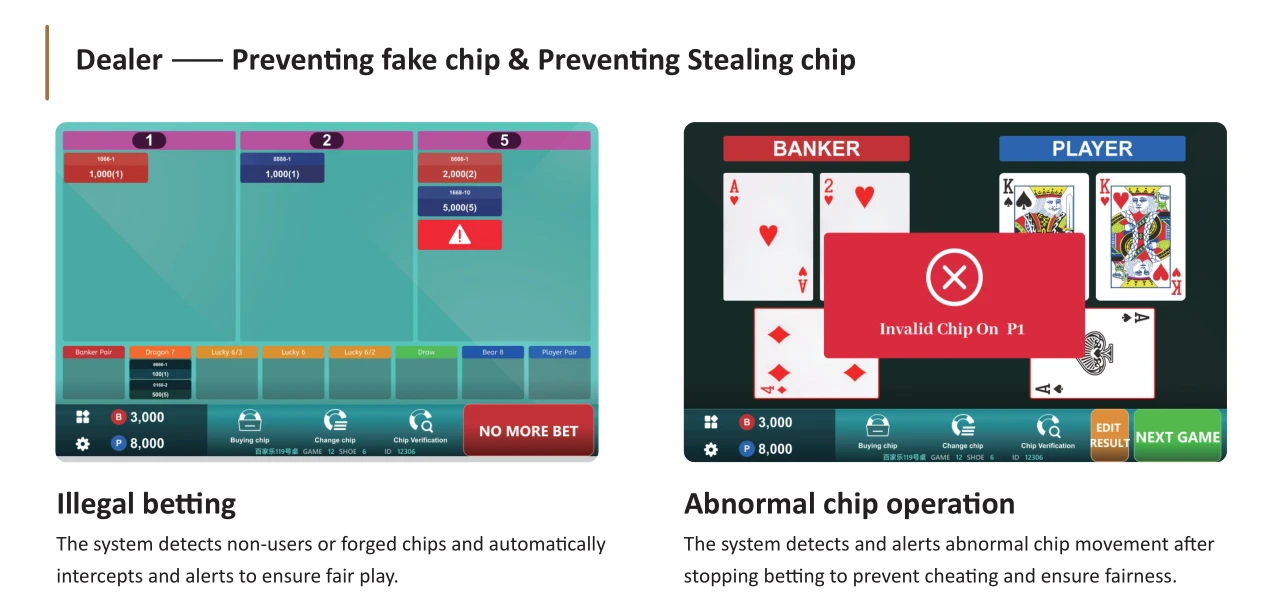
The interface above illustrates two critical alert types. First, fake chip detection: when an RFID reader identifies a chip without a valid serial number or with a denomination that does not match its physical characteristics, the system immediately flags it on the dealer screen. Second, abnormal chip operation alerts: if the system detects chip movements that deviate from expected game flow—such as chips being added to a betting circle after the deal has started—the dealer is notified instantly.
These dealer-facing alerts serve a dual purpose. They empower dealers to intervene in real time without waiting for surveillance to call down to the pit, and they create an auditable record of every alert and response. This documentation is invaluable for regulatory compliance and post-incident investigations. For a comprehensive look at how these interfaces fit into the broader surveillance framework, see our guide to casino surveillance technology and RFID-based real-time fraud detection.
Integrated Display Systems and Camera Recognition
Beyond chip security, casino surveillance systems also leverage camera-based game result recognition to monitor table game integrity. Display systems with integrated cameras—such as those used in roulette—automatically identify winning numbers and cross-reference them against payout data. If the system detects a mismatch between the recognized result and the chips paid out, it triggers a surveillance alert.
The DY10 27″ Roulette Winning Number Display exemplifies this integration. Its built-in camera performs automatic result recognition, feeding data to both the display board and the central surveillance network. This eliminates the need for manual result entry and removes a potential point of human error or manipulation.
For operators building a comprehensive surveillance infrastructure, these display systems serve double duty: they enhance the player experience with real-time game data while simultaneously providing an independent verification layer for surveillance purposes. our casino gaming display system collection includes options for baccarat, roulette, dragon tiger, sic bo, and sangong—each with camera recognition capabilities that feed into the surveillance network.
Calculating ROI: What Casino Surveillance Systems Actually Deliver
The business case for investing in integrated casino surveillance systems is straightforward. Consider a casino with 20 table games generating $50 million in annual table game revenue. At the low end of industry loss estimates (0.5%), the casino loses $250,000 per year to fraud and errors. A comprehensive RFID + AI surveillance deployment typically costs between $200,000 and $500,000 for hardware, software, and installation—meaning the system pays for itself within 12 to 24 months on loss prevention alone.
The ROI extends beyond direct loss prevention. Automated chip tracking eliminates the need for manual table counts, reducing labor costs and human error. Real-time game data enables more accurate comp calculations, ensuring players receive appropriate rewards without overcomping. Surveillance staff can focus on genuine threats rather than reviewing hours of routine footage. And regulatory compliance becomes easier to demonstrate, as every transaction is logged with timestamp, chip serial number, and associated video.
For casinos in regulated jurisdictions, the compliance argument alone often justifies the investment. Gaming commission audits increasingly expect operators to demonstrate verifiable chip tracking and transaction logging. Manual processes and fragmented camera systems no longer meet modern regulatory expectations—integrated surveillance technology is rapidly becoming a license requirement rather than an optional upgrade.
Implementation Roadmap: Deploying Surveillance Technology Across the Floor
Implementing a multi-layer casino surveillance system requires careful sequencing. Phase one typically begins at the cage, where RFID chip readers and management software establish the foundation for chip tracking and authentication. Phase two extends RFID coverage to high-value table games, prioritizing baccarat and blackjack pits where the largest bets are placed. Phase three integrates AI video analytics, connecting existing camera infrastructure to the RFID data stream for cross-verification.
Each phase should include staff training, workflow redesign, and a testing period to validate accuracy before going live. Casinos that attempt to deploy all layers simultaneously often face integration challenges and operator pushback. A phased approach allows surveillance teams to build confidence with each technology layer before adding the next, ensuring that the system delivers measurable security improvements at every step.
Equipment selection is equally critical. Casinos should prioritize hardware and software from vendors with proven gaming industry experience, as consumer-grade RFID and camera systems lack the precision, durability, and regulatory certifications required for casino environments. All equipment should support open data protocols to ensure interoperability with future technology additions.
Frequently Asked Questions
How do casino surveillance systems detect counterfeit chips?
Casino surveillance systems detect counterfeit chips primarily through RFID technology. Each genuine casino chip contains an embedded microchip with a unique serial number and denomination code. When the chip passes over an RFID reader—at the cage or embedded in a gaming table—the system verifies its authenticity in milliseconds. If the chip lacks a valid RFID signature or has been flagged as stolen, the system triggers an immediate alert to both cage staff and the surveillance room.
What is the typical cost of implementing RFID casino security?
A full RFID casino security deployment—including RFID-embedded chips, table antennas, cage readers, and management software—typically costs between $200,000 and $500,000 for a mid-sized casino with 15–25 table games. The exact cost depends on the number of tables, chip inventory size, and software integration complexity. Most casinos achieve full ROI within 12 to 24 months through reduced fraud losses, improved operational efficiency, and lower labor costs for manual counts.
Can AI video analytics replace human surveillance operators?
AI video analytics cannot fully replace human surveillance operators. AI excels at monitoring multiple feeds simultaneously and flagging anomalies based on pattern recognition, but human judgment is required to interpret context, make final determinations, and coordinate responses. The most effective casino surveillance systems use AI as a force multiplier—filtering routine activity so that human operators can focus on flagged events that require investigation.
How does real-time fraud detection integrate with existing camera systems?
Real-time fraud detection integrates with existing camera systems through a central surveillance server that aggregates data from RFID readers, AI video analytics, and dealer interfaces. When the RFID layer detects an anomaly, the system automatically pulls the corresponding camera feed and presents it to the surveillance operator with a timestamp and alert context. This integration does not require replacing existing cameras in most cases—it requires adding an analytics layer that can process existing video streams alongside RFID data.
Conclusion
Modern casino surveillance systems represent a fundamental shift from reactive monitoring to proactive fraud prevention. By integrating RFID chip tracking, AI video analytics, dealer-facing alert interfaces, and camera-based game recognition, casinos can create a real-time security net that protects every transaction on the floor. The technology pays for itself through prevented losses, operational efficiencies, and regulatory compliance—while providing the auditable evidence that modern gaming regulators increasingly demand.
For casino operators and procurement managers evaluating surveillance upgrades, the key takeaway is that no single technology layer is sufficient. RFID without video lacks visual verification. Video without RFID lacks transactional precision. The power lies in integration: a unified system where every chip, every camera, and every alert feeds into a single operational picture. That is the architecture that defines the next generation of casino security.